



Credit Nexford University
Entrepreneurship isn’t what you see on the news or what is taught in Harvard lectures. True entrepreneurs simply have “more” - what does this mean?
Reading Time: 11 minutes for full analysis + key takeaways highlighted throughout
Key Question: What are the key aspects of entrepreneurship?
My Take: The reality of entrepreneurship is incredibly different than what’s portrayed in media, written in books, or taught in Harvard lectures. In a way, the following is no different. As I am not an entrepreneur, my view is not one of tried-and-true experience, but rather through seeing what’s been discussed, mentioned, or otherwise proclaimed about the concept of entrepreneurship and pulling the common thread throughout. The key aspects of entrepreneurship rarely line up, but they’re critical to success, mindset, and an entrepreneur’s overall approach.
Refer a Friend - Earn These Rewards
Let’s dive in.
I am not an entrepreneur.
I’ve never founded a company, been part of a company’s early stages, or seriously considered starting one myself.
In that sense, I am one of the last people you would imagine having differentiated thoughts on entrepreneurship. For tacit knowledge is far superior to explicit knowledge.
Thousands of books, millions of articles, hundreds of thousands of public speeches and lectures, thousands of university professors, and many more have weighed in on entrepreneurship.
Why am I different?
I am an outsider. I don’t profess to know anything through direct experience; I simply notice patterns in what people do and what people who do know things write about.
There’s a common thread underlying these topics, one that goes largely unnoticed and unreported, yet one that is critical when determining an entrepreneur’s success.
My aim today isn’t to provide another list of entrepreneurial qualities we should all seek or to offer an all-inclusive guide to success; rather, it is to highlight aspects of entrepreneurship that are critical to success yet often overlooked. Often, these appear in various places but rarely together, showing their interplay and necessity for success.
The Common View of Entrepreneurs vs. The Reality
The quintessential founding story starts with a garage or a bedroom. Every entrepreneur has to start somewhere; often, the lowest-friction environment is the safety and confines of your own home.
These entrepreneurs are often high school or college dropouts, romanticized for keeping on tinkering with their ideas until they stumbled upon something that “worked.” Initial customer wins began a continuous wave, turning the idea from a small drop of water into a maelstrom. Funding sources all desperately compete for the smallest share of this rocket ship, naively presenting a vision of the “world to come” and capitalizing on the scarcity of being the “next big thing.”
Unlike what you may read in your Harvard Business School case studies or the edge cases you see in the news, entrepreneurial reality is far different from this utopian viewpoint consistently paraded around.
To begin, MIT researchers found that the mean age of founders who successfully built the 1-in-1,000 companies that became rocket ships was 45.
In a grounded reality, this fact makes even more sense. These individuals have often spent the last 10-20 years in that industry, have significant practical experience under their belts, and, most importantly, know the pain points firsthand and have theories on how to fix them.
In fact, well-known brand names were founded by enlightened individuals over 40. These include Walmart, Comcast, Ford Motor Company, Workday, Coca-Cola, KFC, Dior, Adobe, Nestle, Red Bull, and many more.
These findings strongly reject the widely spread ideal that youth is a key trait of successful entrepreneurs—yet thousands of students still graduate with entrepreneurship degrees each year.
When you hear the founding stories of current billionaire entrepreneurs, the media often criticizes their idealized “founding story”, uncovering it for what it really is. Elon Musk comes from a wealthy South African background. Mark Zuckerberg got $100,000 from his parents to start Facebook. Generational wealth, connections, and assistance drove the initial stages of Microsoft, Dell, Nike, Amazon, and many more.
Family money, connections, and background (often a notable last name) play a critical role in entrepreneurship. It’s one of the primary sources of funding for startups—ahead of bank loans or venture capital.
Researchers found a high correlation between your parents’ income and your chances of becoming a startup entrepreneur. This was the most important factor in the likelihood of starting a business, largely because it provides a financial safety net.
Contrary to intuition, although these founders are better capitalized, the chances of entrepreneurial success aren’t dramatically different. In fact, research found that founders who received investments from parents, family members, or close friends were less likely to take risks and grew more slowly than those funded by an outside source.
So what truly powers an entrepreneur if it’s not youth or raw capital?
Often it’s a fundamental detachment from statistical odds. Researcher Thomas Astebro demonstrated that returns on inventions (i.e., returns on early-stage entrepreneurs) are far lower than those on venture capital.
Startup failure statistics are dismal. If failure means liquidation, then the failure rate for startups is 30-40%. If it’s failing to see the projected return on investment, it’s 70-80%. If it’s defining a projection and then falling short of meeting it, then it’s 90-95%.
To function with these statistics, entrepreneurs need to maintain some blindness/naivety to the odds and an obsession with their own positive Black Swans. Hope is critical.
Economist and writer Amar Bhide found that “Entrepreneurs don’t care about the statistical likelihood of a business like theirs failing.” They care about their own businesses. “They make their judgments through some combination of imagination and the facts of the matter at hand.”
An entrepreneur’s decision-making process is not a rigid process with predictable inputs and outputs (Y = MX + B; a science). Instead, it resembles an orchestral piece (an art): an intricate, highly interrelated combination of imagination, facts, designs, and conduct. Entrepreneurs don’t evaluate choices through cold, objective algorithms; they synthesize vision and reality into a complex narrative.
The Core Characteristics of Exceptional Founders
Besides being ~45, from generational wealth or not, and having naive, lottery-winning-like confidence, what makes one entrepreneur more likely to succeed than another?
Conventional startup advice lists often miss the mark here. For instance, Harvard Business School published an article on the “10 Characteristics of Successful Entrepreneurs”, including the following: curiosity, willingness to experiment, risk tolerance, comfort with failure, persistence, adaptability, decisiveness, innovative thinking, self-awareness, and long-term focus.
Don’t get me wrong, all of these characteristics are good in an entrepreneur, but in my opinion, they don’t “make” an entrepreneur—for instance, elementary teachers exhibited these traits (teaching kids to read in innovative ways, adapting to stresses, failures, innovating, and being self-aware when things with the “troubled students” didn’t work out, yet continually trying again to drive long-term gains), but they aren’t world-class successful entrepreneurs (but they did create a great foundational knowledge that has helped me get to where I am today).
True entrepreneurs I’ve met simply have “more.” They create obsessive depth and systemic visions around their core niche. They have deep curiosity and bottomless, nuanced knowledge, holding the entire system in their heads—from the 50,000-foot view (the forest) down to the millimeter (the seed). Try digging into a founder’s product with them for 5-10 hours straight, and you’ll see exactly what I mean—they’ll chat your ear off.
Successful entrepreneurs exhibit a bias towards action and iteration. Why talk the talk when you can walk the walk? As Ash notes in LeanFoundry, “The most successful founders pack more iterations per unit of time than others.” Relentless execution accomplishes more—increasing your chances of success if you can build more, fail more, communicate more, learn more, read more, network more, more, more, and more.
You know you’ve met an entrepreneur who exhibits these traits. They have the rare ability to attract and pull the best work out of world-class people. I’ve met many founding teams where some of the absolute best individuals in their fields worked and collaborated to achieve a utopian vision of the world. It takes a special individual to bring these people together.
Entrepreneurs do showcase persistence, but it is so much more than that. They possess a tireless work ethic, adaptability, and an unyielding commitment to solving a massive puzzle. The best entrepreneurs are those who can’t afford to fail. Warriors do their best fighting when their backs are up against the wall.
Great founders aren’t found in the middle, in the median, mode, or average. They’re almost always found at the extremes. Iconic creators are completely obsessed with their craft—they live their business, not simply working it as if it were a job or a hobby. Entrepreneurship is a way of life. Michael Tefula writes in his publication VC Mastery, “Whether it’s the founder of Ferrari working 12-16 hours every day, James Dyson iterating through 5,000+ designs of a vacuum cleaner, or Estée Lauder obsessing about what cosmetics can do for beauty, great founders have one thing in common: They’re extremes, not moderates.”
Strategy, Systems, and the Art of Decision-Making
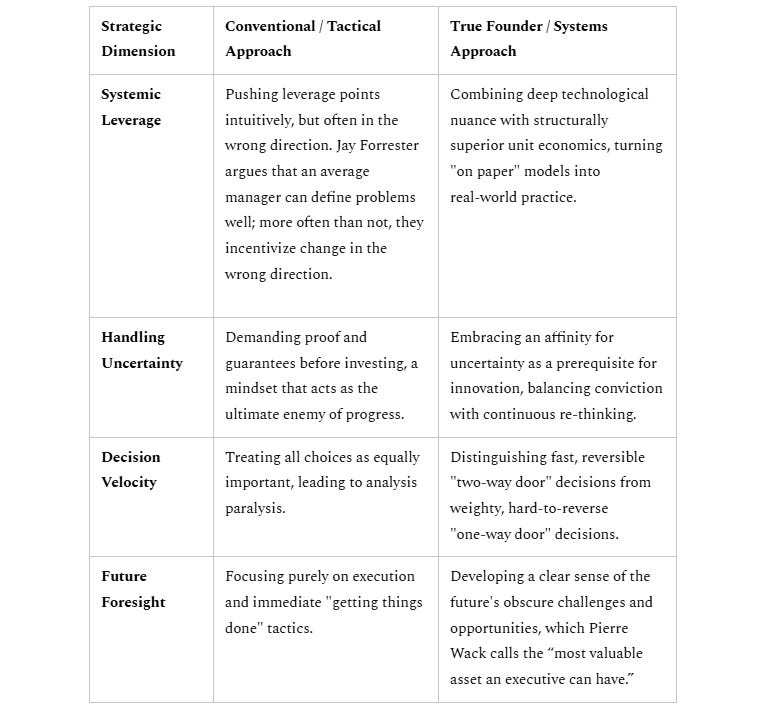
Most startup advice focuses on tactics: developing a good idea, a good business model, sizing the market, interviewing customers, determining demand, and building a minimum viable product. Tactics are merely the means of getting from A to B, the modes of travel. Strategy is the route on the map.
Tactics govern the short term; strategy determines who survives the distance. The long-term question every unicorn-seeking entrepreneur is answering is “how do we get to be a dominant company in a massive market?” Answering this question is strategy. It’s not as simple as “we’ll win because we’re better” or “someone will take this entire market; it might as well be us.”
A good strategy combined with an exceptional entrepreneur is a recipe for becoming and remaining dominant in a large market by deterring or delaying competition.
Succeeding on this journey is incredibly difficult, as it requires mastering complex systems and managing uncertainty.
Inward vs. Outward Perceptions
In Silicon Valley and throughout the United States, founders often occupy a unique space in the business world. Tina He writes in Fakepixels, “They are extreme insiders by their power and vision, yet often extreme outsiders in their eccentricities and willingness to break convention. The result is a strange hybrid: manufactured mythology running on engagement metrics, where founders must navigate between being deified and demonized.”
Within Silicon Valley, founding stories follow classic hero’s journey patterns: Steve Jobs was the outcast turned hero, Mark Zuckerberg was the boy king, and Elon Musk was the Prometheus figure bringing fire to mortals.
Investors often focus heavily on a founder’s personal narrative. The evolution of founders into sacred figures follows a consistent trajectory: the initial blessing (receiving venture capital funding), a period of adversity (the “valley of death”), and the eventual triumph or failure (which leads back to giving back to other entrepreneurs as an angel, restarting the cycle).
Investors, amid the uncertainty, seek signals to evaluate founders through a framework that prioritizes the following:
The Capacity for Transformation: An entrepreneur’s readiness to shed former assumptions and navigate prolonged uncertainty
The Willingness to Face Ordeals: An entrepreneur’s endurance to survive the “valley of death.”
The Potential for Restoration: An entrepreneur’s ability to bring a vision to fruition and rally others into the unknown
However, the line between the attractive narrative and deception is thin. Often, storytelling can detach from substance. Founders can hyper-focus on narrative, spending more time debating the story than the product/user experience. As seen with cautionary figures like Gerald Cotten or Elizabeth Holmes, the attention economy can reward the outward performance of “founding” over the quiet labor of product-market fit, customer retention, and real revenue.
Do Founders Truly Make or Break an Investment?
One of the major questions around entrepreneurship, which likely deserves its own article, is whether founders truly make or break an investment. Are they critical to returns, or are they simply part of a broader package?
The evidence points to an undeniable effect of entrepreneurs on a company’s success. Packy at Not Boring describes how investors view this dynamic:
You’re paid to analyze and invest in businesses, so you do market maps and TAM analysis and pick apart the strategy and dive deep into the technology, compare it to other technologies, map the competitive landscape, track traffic metrics, model out a base case, bull case, and bear case, trade notes with other investors, tap your expert network for their insights, and do any number of things that makes it feel like the investment decision is based on something substantial. You pick apart everything I just wrote about in The Plan, question this assumption or that. You come up with smart-sounding reasons that This Will Never Work. The thing is, though: a truly excellent founder has done all of this, and more.
Exceptional founders have spent years analyzing these dynamics with a depth no external observer can fully match. In building their company, they are committing years of their life when they have countless other elite options competing for their time.
Investing in a founder means choosing to believe what they believe, despite a potential lack of objective evidence or rational odds. They recognize that a unique founder can make authoritative decisions, inspire deep loyalty, and plan for decades in a way an interchangeable manager could not.
Ultimately, entrepreneurship is a self-actualizing and self-transcending activity. Nassim Taleb puts it perfectly in his book Antifragile:
Most of you will fail, disrespected, impoverished, but we are grateful for the risks you are taking and the sacrifices you are making for the sake of the economic growth of the planet and pulling others out of poverty. You are at the source of our antifragility. Our nation thanks you.
That’s a wrap on this deep dive.
Drew Jackson
Founder & Writer
Found this analysis valuable? The best way to support Brainwaves is to share it with someone who’d benefit from these insights.
Refer a Friend
Building this community has been one of the most rewarding parts of writing Brainwaves. If you know someone who’d enjoy these weekly deep dives, I’d love it if you could share your unique referral link with them. You’ll earn tangible rewards for growing our community, and they’ll get content worth their time. Win-win.
Keep Exploring
Next Deep Dive: Your Education Doesn’t Stop When You’re 22 - October 14th, 2026
This Saturday: Weekly roundup of breaking developments across energy, space, venture capital, economics, intellectual property, and philosophy
Previous Editions: View the archive here
New to Brainwaves? Join hundreds of readers getting bi-weekly deep dives into the forces reshaping our world.
Sponsor This Newsletter: Reach an engaged audience of forward-thinking readers. Email us for details.
Disclaimer: Views expressed are personal opinions, not financial advice. This content is educational only. Investment decisions carry risks - always consult professionals and do your own research. All sponsorships are clearly disclosed.
© 2026 Brainwaves. All rights reserved.