



Credit Marco Furniture
I often make New Year’s Resolutions I honestly don’t expect to complete. But I continue making them every year. Why?
Reading Time: 9 minutes for full analysis + key takeaways highlighted throughout
Key Question: Why do we love lying to ourselves?
My Take: Everyone lies to themselves more often than they think, from New Year’s resolutions to AI output to many other situations. We use this self-deception to avoid facing harsh truths and honest realities. There isn’t an easy solution to this problem because we need to build more structural systems that cut to the core of each issue and flip incentive cycles.
Refer a Friend - Earn These Rewards
Let’s dive in.
Over the last four years, the world has become entrenched in the new age of AI. This has forced people to learn, relearn, and adapt to the new way the world is and will be for the foreseeable future.
In school, teachers are going back to in-person, handwritten tests and assignments. On social media, AI images are everywhere, with various degrees of accuracy in representing real life. In corporate settings, many firms are reluctant to adopt these tools—citing data privacy, security, and learning concerns.
One of the main messages proclaimed throughout modern news cycles and intellectual circles is to triple-check AI output to ensure accuracy. AI output is not fact; it can be wrong, and should be verified.
This takes time and effort—which, I’m sorry to say, causes many (including myself at times) to simply take what’s outputted as hard fact, without going through the proper verification process. There are thousands of reasons people use to justify this practice, which tends to lead to increasingly unverified use due to convenience and muscle memory.
Why do we continue this practice, even though we know better?
Credit The Guardian
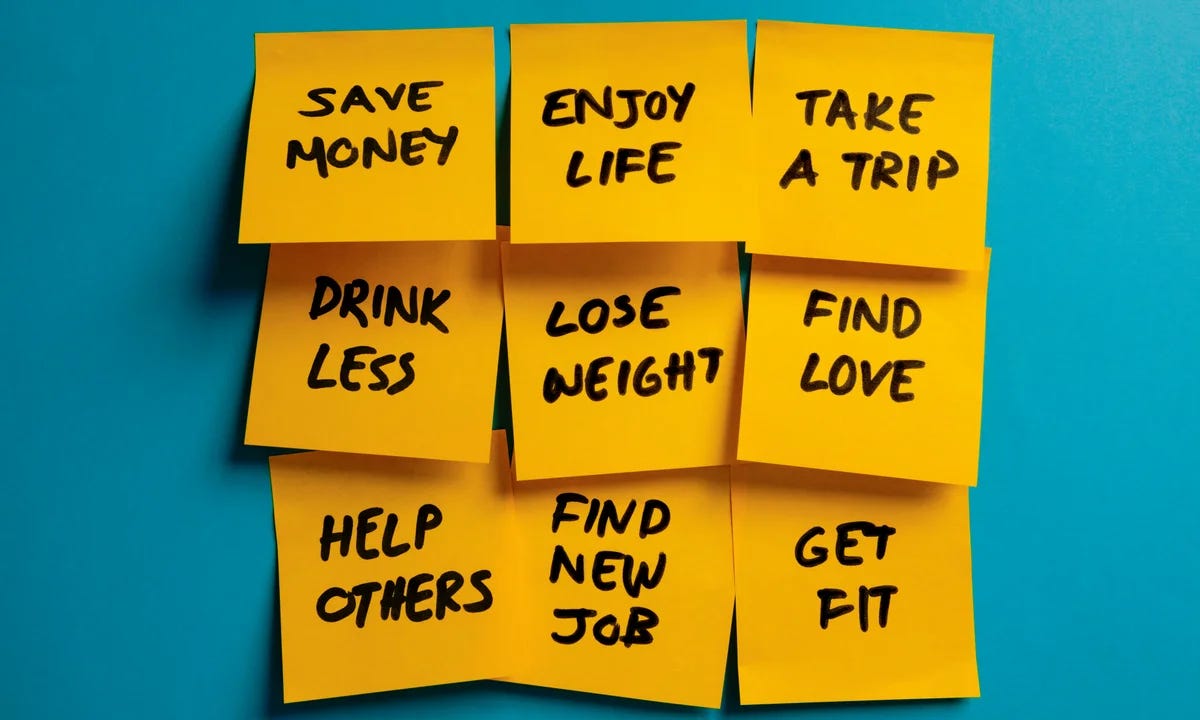
The Ritual of Resolutions
For the last 5 years, I’ve made official New Year’s resolutions. Looking back at my performance, I’d estimate that I succeed in 50% of them (usually the easy ones).
Some of the harder ones missed (play piano once every week or run a half-marathon) require a concerted effort towards an extensive initiative. I’ve often seen myself set these goals with decent intentions to try to do them, while knowing in the back of my mind they probably won’t be achieved.
Why do we continue to deceive ourselves by setting outrageous goals without the intention to see them through?
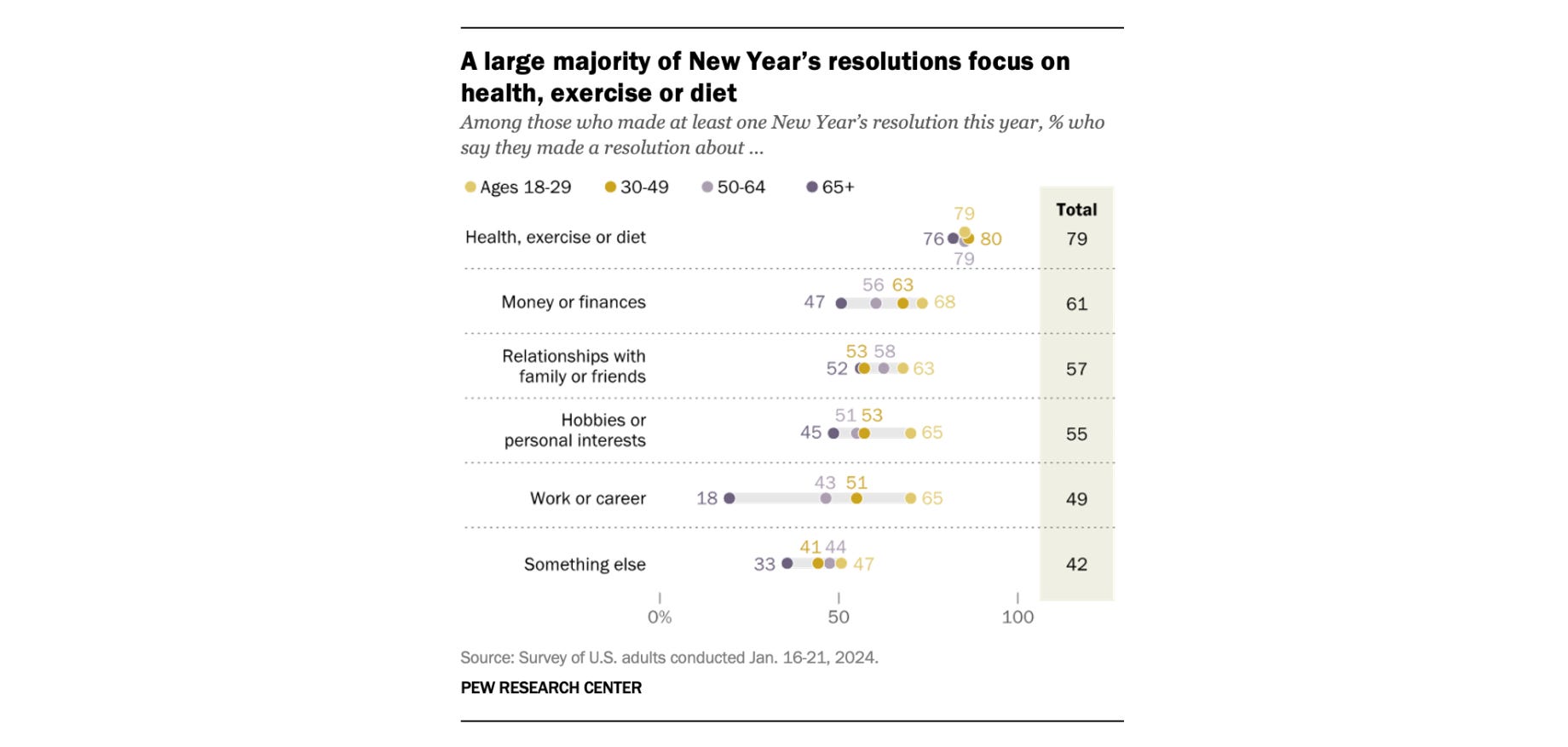
The data surrounding New Year’s Resolutions is fascinating. For instance, the Pew Research Center publishes a significant data pack on the topic, including demographic, topic, and other analyses.
They found that younger people are much more likely to make New Year’s resolutions than older generations (49% for ages 18-29, 31% for ages 30-49, 24% for ages 50-64, and only 18% for ages 65+). 54% of parents with kids at home are likely to set resolutions compared to only 33% of those without kids. The most common topics of resolutions are shown below:
Credit Pew Research Center
A similar study conducted by Forbes found the top New Year’s resolutions to be improving fitness, finances, and mental health; losing weight; improving diet; and making more time for loved ones. Around half of people state they tend to set three New Year’s resolutions, with only ~7% setting five or more.
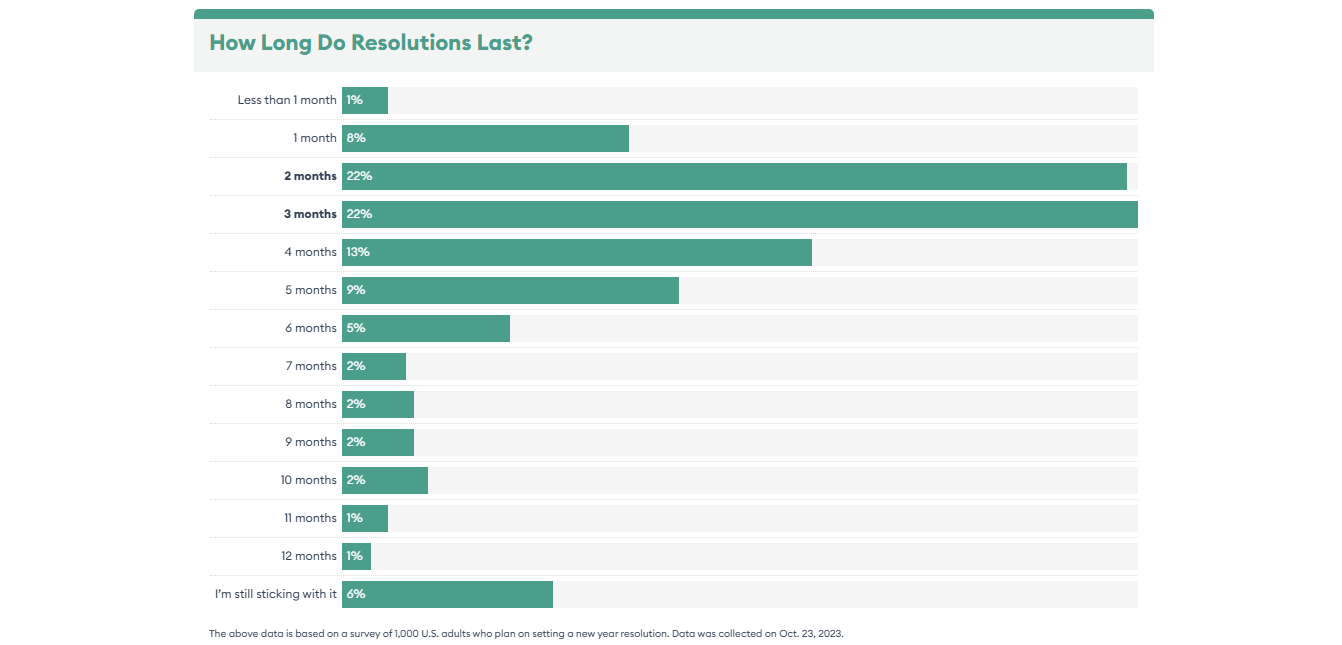
What’s more interesting is the percentage of people keeping their resolutions. At the beginning of February (one month in), 59% reported keeping all their resolutions, 28% kept some, and a shocking 13% kept none. Interestingly, there are only small demographic differences underlying this data, meaning that groups of all shapes and sizes tend to struggle (and/or be overrepresented) in achieving their goals. Forbes provides a further detailed breakdown:
Credit Forbes
Furthermore, the types of goals you set matter significantly when it comes to chances of success. For example, action-oriented goals are more likely to result in success after 12 months than avoidance-oriented goals (59% compared to 47%).
My theory is that New Year’s resolutions and other goals we set provide a quick hit of dopamine when we declare them, rather than when we actually do the work of achieving them. Resolutions allow us to test out and envision a better version of ourselves without the cost of entry.
Often, we aren’t failing at the goal; we’re succeeding at feeling like the kind of person who has goals.

Credit Shezlong
Just One More Time
The human brain is a brilliant rationalization machine. When a desire conflicts with our long-term goals (outlined above), we don’t simply abandon the goal all at once. Instead, we negotiate with ourselves.
We use the language of equity and reward to justify our behavior. A common practice is moral licensing, a phenomenon in which doing something we consider good or virtuous makes us feel entitled to subsequently indulge in less ethical, unhealthy, or lazy behaviors. People use their past positive actions as a moral pass to justify negative choices.
For instance, I’ve used this practice in the past, such as: “I did a good job during my workout today, so I deserve to eat this stack of Oreos.”
We trick ourselves into treating a destructive or unproductive habit as a form of self-care. By framing the action as an earned reward or an emotional necessity, we bypass the guilt.
Why is it so easy to borrow happiness from tomorrow to pay for a thrill today?
In addition to moral licensing, we often fall prey to the cognitive bias of temporal discounting. This is a cognitive bias where people perceive future rewards or consequences as inherently less valuable than immediate ones.
A common psychology experiment demonstrating this principle asks people whether they would prefer an amount of money now (say, $100) or a greater amount in the future (say, $110).
Often, the brain treats our future self as a stranger, reducing motivation to make sacrifices today for tomorrow’s benefit. From a neurological perspective, when you think about your future self, your brain fires in the exact same region it does when you think about a complete stranger.
We view this version of us that exists next year, next week, or even tomorrow as a different person entirely. The present self desires immediate gratification, wanting the dopamine hit now. The future self is viewed as a faraway entity with infinite patience, ironclad willpower, and an uncanny ability to function on minimal sleep.
This disconnect creates a massive empathy gap. We’re more than happy to stick future us with the bill—the lack of sleep, the empty bank account, the sadness, the grief—while the present version of ourselves reaps the rewards.

Credit HowStuffWorks
The Mirage of Truth
Underlying the examples above is this mirage of truth: we don’t lie to ourselves because we are unintelligent; we lie because the truth is often a high-friction environment. Thus, our self-deception is a strategy for comfort.
In others, we look at self-deception as a moral failing or a significant flaw. We assume that if someone is self-aware enough or smart enough, they will be able to see the world clearly. But this is a fundamental misunderstanding of the human mind.
We don’t lie to ourselves because we are stupid; we lie because we are wired to seek the path of least resistance.
In nature, friction is the force that resists motion. When water runs down the mountain, it slowly carves ravines and ditches to run through, curating the path of least resistance that future water compounds upon.
In humans, truth is much more complicated, exhibiting greater friction. Looking at a situation with absolute honesty requires immense energy and clarity. It requires looking at uncomfortable realities (e.g., failed projects, stagnating relationships, missed goals). Accepting this truth is painful, often requiring us to rewrite our self-image.
Truth is heavy and expensive. In contrast, deception is smooth, allowing us to glide past uncomfortable realizations without doing the hard work of changing.
When we’re in these situations, our brain has two options: truth or deception. We can either change our behavior, a high-energy, high-friction outcome, or we can change the narrative, a low-energy, low-friction outcome. In most scenarios, the brain chooses option 2.
By constructing a mirage of truth, we insulate our egos from threat. For example, the entrepreneur tells themselves and others that the market just isn’t ready, rather than admitting their product has no demand. We tell ourselves we are waiting for the precise moment rather than admitting we’re paralyzed by fear.
We struggle to hold two contradictory beliefs at the same time. For instance, the fact that our New Year’s resolution was to eat healthy every single day, while we’re currently sitting on the couch halfway through a bucket of ice cream. In this circumstance, the brain experiences cognitive dissonance.
In these circumstances, self-deception acts as a calming, easy solution. By generating a quick lie, like “this ice cream keeps me happy, which is actually healthier for me”, the brain instantly resolves the contradiction.
If we were 100% honest about flaws, limitations, and the odds against us, human history would have stalled very early on. Evolutionary psychologists have theorized that a certain level of delusion and overconfidence is necessary for survival and thriving.

Credit The University of Kansas
Is There Any Hope?
We truly do love lying to ourselves.
Over time, we’ve evolved this system, which we now rely on, in which we engage in self-deception rather than facing harsh truths.
Unfortunately, there is no “easy” solution; this is not something we can simply cure with willpower alone. It’s not as easy as telling ourselves to start being honest, because we’re too clever for that.
To break these cycles, we need to build more structural systems that bypass our ego and emotions to cut straight to the core of each issue. We need to flip the incentive cycles, making truth a low-friction environment and self-deception come at a high price.
The brain easily rationalizes away scenarios, but struggles to defeat cold, raw facts. To stop lying to yourself, you need to move the data outside of your head into spreadsheets, journals, conversations with other people, and many other places. This creates a source of external accountability and transparency that keeps us closer to being on track.
Additionally, we need to force our present selves to give adequate consideration to the future. Good examples I’ve used in my life are setting time limits on social media apps or moving my alarm clock across the room, so I actually have to get up to hit snooze.
We lie because the truth is often hard to bear. If we want to accept the truth more often, we have to lower the cost of being wrong (i.e., having the truth go against our views of the world). One great way to do this is to adopt a growth or learner’s mindset. Finding out you are wrong in this mindset is an opportunity for positive action, rather than a negative reaction.
Perhaps the simplest way to evaluate and change our behavior is to practice open awareness. Ask yourself questions such as “Are there any parts of my life stagnating or frustrating now? What uncomfortable truths am I actively pretending not to know right now?”
The answers that come as a result, the ones that may put a sour taste in your mouth, are right where the self-deception ends and the truth begins—where action starts, and lies stop.
That’s a wrap on this deep dive.
Found this analysis valuable? The best way to support Brainwaves is to share it with someone who’d benefit from these insights.
Drew Jackson
Founder & Writer
Refer a Friend
Building this community has been one of the most rewarding parts of writing Brainwaves. If you know someone who’d enjoy these weekly deep dives, I’d love it if you could share your unique referral link with them. You’ll earn tangible rewards for growing our community, and they’ll get content worth their time. Win-win.
Keep Exploring
Next Deep Dive: Carrots, Sticks, and Kilowatts - August 19th, 2026
This Saturday: Weekly roundup of breaking developments across energy, space, venture capital, economics, intellectual property, and philosophy
Previous Editions: View the archive here
Stay Connected
New to Brainwaves? Join hundreds of readers getting bi-weekly deep dives into the forces reshaping our world.
Sponsor This Newsletter: Reach an engaged audience of forward-thinking readers. Email us for details.
Disclaimer: Views expressed are personal opinions, not financial advice. This content is educational only. Investment decisions carry risks - always consult professionals and do your own research. All sponsorships are clearly disclosed.
© 2026 Brainwaves. All rights reserved.