



Credit Southern Living
Demand is a complicated art that can make or break a business. Understanding its intricacies can be the difference between success and failure.
Reading Time: 11 minutes for full analysis + key takeaways highlighted throughout
Key Question: How can you better understand demand to maximize your chances of success in business?
My Take: Demand is one of the simplest economic principles, yet it is often one of the most critical and often misunderstood aspects of business success. For a business, demand drivers can push it higher or cause contractions, shaping short- and long-term strategy. Importantly, demand almost always behaves in a standard way, except for free goods and Veblen goods. These dynamics and more can be the decider between success, mediocrity, and failure.
Refer a Friend - Earn These Rewards
Let’s dive in.
I find collections of objects fascinating.
Almost everyone in my life collects things of various shapes, forms, costs, and more.
I know people who collect stamps, coins, Hot Wheels cars, nativity sets, cars, Legos, Funko Pops, and much more. From everyday objects to eccentric choices, collections are an important way for people to showcase their passions, have a creative outlet, and otherwise brag to the neighborhood Joneses.
Personally, I collect cool shoes under <$50. I’ve got over 50 pairs of shoes to my name, many of which are unique and interesting (and also under $50,000). Shoes have a certain level of practicality compared to other collections I’ve witnessed.
I wouldn’t go so far as to say I’m addicted to buying shoes, but I’m definitely a high-volume consumer. I’m always looking for the next deal, the next drop, the next discount.
Some days, I buy a pair of shoes as a reward for hitting a milestone in my life. On others, they’re purchased opportunistically (you can’t afford to), and on others they’re purchased just cause I can.
In other words, my demand for shoes, although it fluctuates often, is relatively high.
On the surface, demand is an incredibly simple topic (the demand for a real estate agent is the number of people using that agent to find houses). Within business, demand is one of the most critical determinants of success; if people don’t like your product/service and demand it, you will quickly go out of business.
Yet, even in a close-knit business conversation, the concept of demand isn’t fully understood or clearly laid out.
Demand is one half of the essential economic yin-yang between supply and demand, without which our economy and planet as we know it would likely struggle to thrive as it does.
It underpins consumer behavior, business success, cultures, trends, fads, politics, social situations, and societies, and it penetrates almost every facet of human life. As such, fully grasping the intricacies of demand can pay dividends throughout your entire life.
Holistic Demand
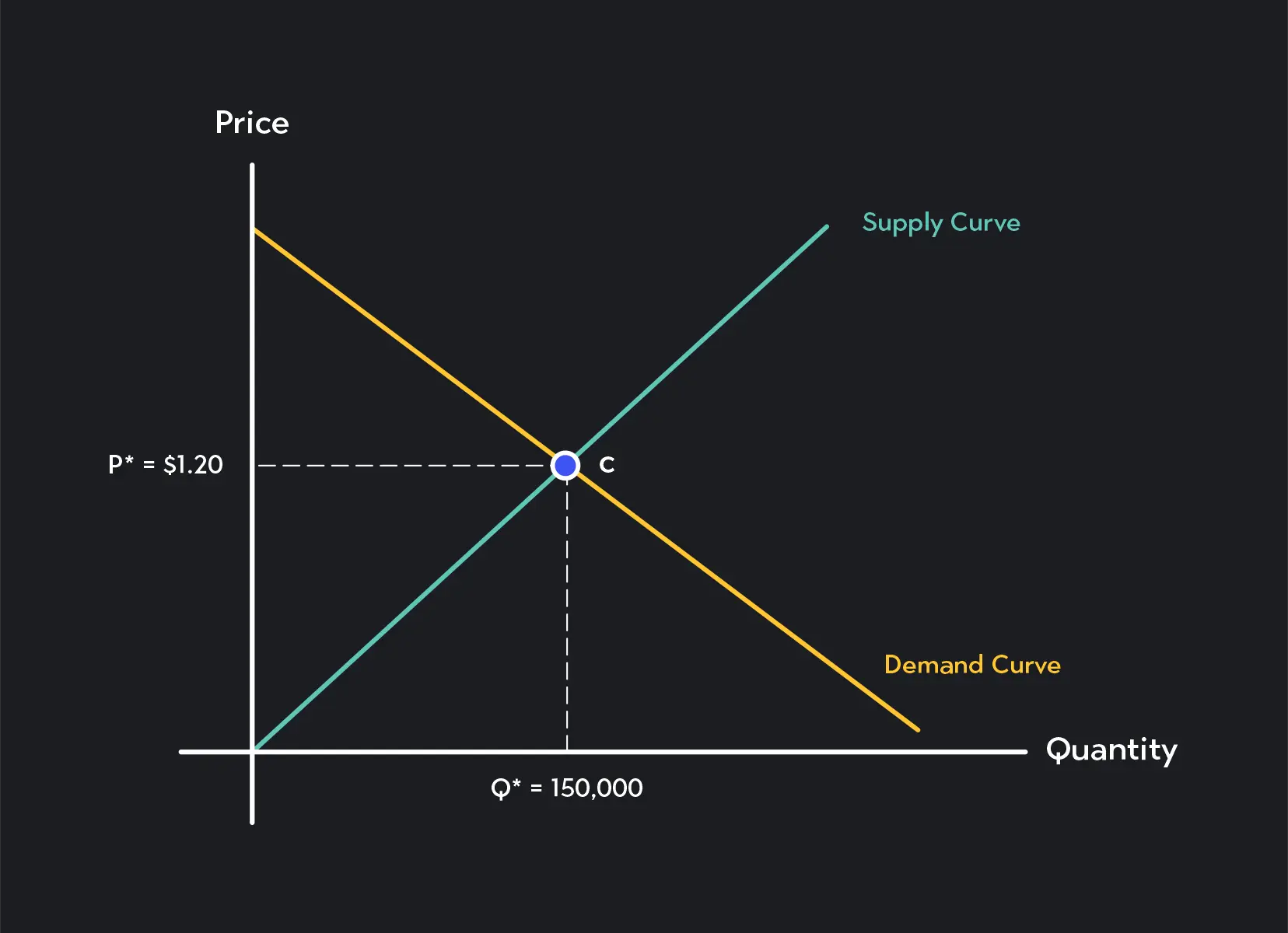
In Econ 101, the first lesson covers the two most critical parts of any economy: supply and demand. Often that’s accompanied by a graphical representation like the one below.
Credit Outlier
At a very basic level, demand is a consumer’s desire to purchase a good or service. This is combined with their willingness and financial ability to pay for the good or service at a given price.
Desire alone isn’t demand from an economic perspective; it also requires purchasing power. I may desire a Ferrari, but if I don’t have the purchasing power, I don’t have demand (from an economic perspective).
Interestingly enough, most people don’t know what they want until they see it in the context of other deals and offers. Dan Ariely, in his book Predictably Irrational, notes this interesting example:
High-priced entrees on the menu boost revenue for the restaurant—even if no one buys them. Why? Because even though people generally won’t buy the most expensive dish on the menu, they will order the second most expensive dish.
One of our most common ways of evaluating, which cuts right to the heart of demand dynamics, is in relation to other comparable products or services. This applies to cars, jobs, dating, therapists, lawn care providers, and many other goods and services.
Outside of traditional economics, demand is a core structural framework spanning psychology, engineering, law, biology, and systems theory. In these contexts, demand represents a constraint, load, requirement, or pressure exerted on a system. For instance, in psychology, environmental requirements (e.g., at a job, this would be workload) demand cognitive energy and resources, increasing the risk of burnout.
Returning to an economic context, demand originates from the combination of human needs, preferences, and economic capacity. Humans consistently have unmet needs and desires for utility, comfort, survival, happiness, status, problem-solving, and more. For those with purchasing power (disposable income or ability to buy on credit), this enables a purchase.
Ultimately, demand is driven by a perceived value—the benefit a buyer expects to receive relative to the price. This is the buyer’s net outcome, and it often drives the decision to purchase or acquire the good or service.
The world is consistently changing. Consumer preferences constantly shift with the latest trends; businesses always chase the next dollar; everything is in constant transition.
Demand drivers change in a similar fashion, causing repercussions throughout the economy. Luckily, demand moves in only two directions: it either increases or decreases.
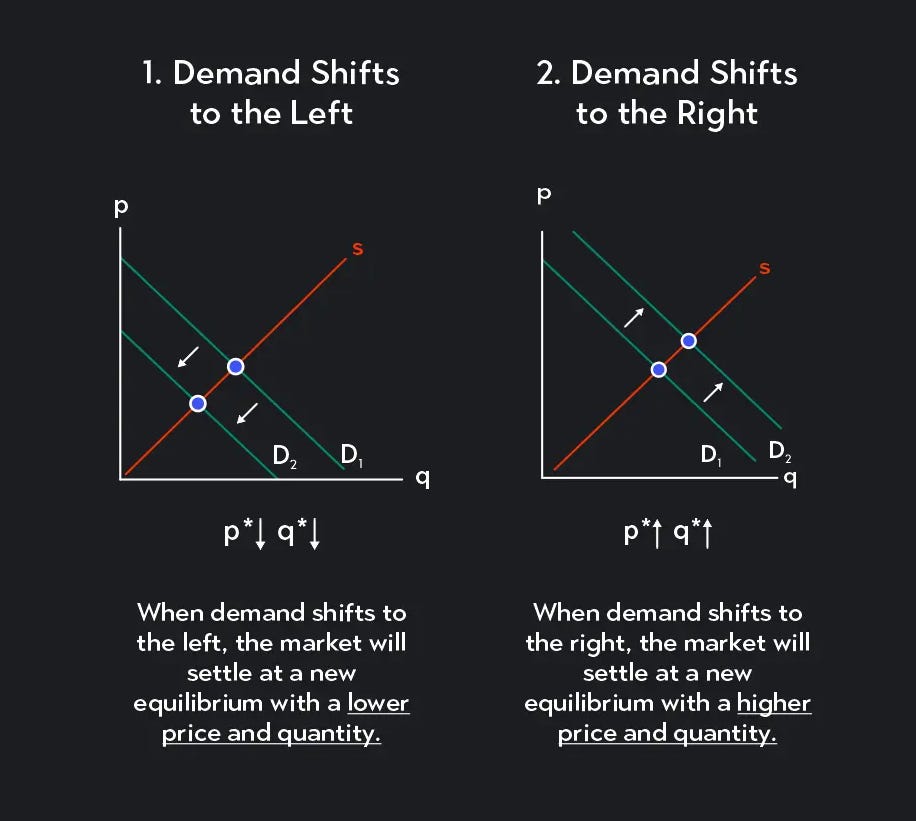
As shown in the graph below, when demand increases, the demand curve shifts to the right (up) from D1 (the original curve) to D2 (the new curve). Based on economic theory, assuming all other factors remain equal, this leads to higher prices and higher quantity sold. This signals to the market that capital and labor should flow into the industry to build additional capacity to meet demand.
Similarly, when demand decreases, the demand curve shifts to the left (down). Under the same logic, this will lead to a decrease in price and a decrease in quantity sold. This signals contracting margins, forcing consolidation, layoffs, or capital reallocation to other sectors.
Credit Outlier
Hundreds of factors can increase demand. Often, these are segmented into 5 key areas that depict the most common occurrences of economic demand increases:
Rising incomes: Buyers have more disposable income for products and services
Shifts in consumer preferences: Positive trends, virality leading to adoption, favorable news, and more social influences driving increased demand
Prices of related goods: Price increases for substitute goods (e.g., the price of the generic coffee bean increases, leading to the relative price of the branded coffee bean feeling “less expensive”, leading to increased demand for the branded coffee bean) or price drops for complementary goods (e.g., the price of peanut butter goes down so the sales of jelly go up as people buy more peanut butter and want more jelly to go with it)
Demographic growth: Growing populations lead naturally to increased demand
Future expectations: Anticipation of higher future prices or upcoming shortages leading to preemptive buying (showcased throughout the start of the COVID-19 pandemic)
In a similar vein, consumer demand often decreases for several reasons. Conversely, consumer demand can decrease when incomes decline, tastes change negatively, substitutes become cheaper, demographics shift, or negative sentiment about the future rises.
The Extremes of Demand Dynamics
For companies, demand often signals success. Successful companies garner additional demand, which increases their success and perpetuates the feedback loop.
Companies with no demand signal a complete lack of value and require a significant pivot to reframe the value proposition or to exit the market.
Limited or low demand signals a niche market, poor market fit, or an overpriced offering. To succeed in this stage, companies can optimize cost structures, target specialized segments, or discount to clear volume.
Companies with medium demand showcase stable market equilibrium with steady, predictable consumption patterns. This enables focusing on brand differentiation, customer retention, and steady operational efficiency.
High demand indicates strong market fit, scarcity, or an underpriced product. Companies in this stage can increase production capacity, expand margins using price increases, and defend against new entrants.
In most circumstances, demand works exactly as described above. In these cases, demand is driven by a combination of standard price factors and non-price factors. A change in the price of the good or service causes a movement along the existing demand curve (a change in quantity demanded), whereas non-price factors shift the entire demand curve left or right.
Price often acts as an original anchor for goods and services. Initial prices are often arbitrary, but once established in our minds, they affect present and future prices. Once you pay a certain price for a product, you judge your willingness to pay for other items in the same product category relative to that first price.
In this way, price and our first decisions in each category resonate and reverberate over a long tail of additional decisions.
Outside of price, there are 5 major factors that directly shift overall consumer demand for a good or service:
Consumer Income: For normal goods, demand increases as consumer income rises (e.g., organic produce, new cars). For inferior goods, demand decreases as income rises and demand increases as income decreases.
The Prices of Related Goods: If the price of a substitute increases, the demand for the original good increases (e.g., an increase in tea prices leads to increased coffee demand). If the price of a complement increases, demand for the original good falls (e.g., higher prices for peanut butter reduce the demand for jelly)
Consumer Tastes & Preferences: Shifts based on trends, health considerations, marketing, seasonal factors, or social changes
Consumer Expectations: If consumers expect prices to rise soon, current demand increases as people buy early. If consumers expect their income to rise soon, it encourages immediate spending.
Market Demographics: An expansion in population size, demographic shifts (e.g., an aging population), or opening a product to new geographical markets increase market demand
One interesting example of a demand driver is behavior herding. Dan uses the analogy of a restaurant, which is a perfect example of this:
You’re walking past a restaurant, and you see two people standing in line, waiting to get in. “This must be a good restaurant,” you think to yourself. “People are standing in line.” So you stand behind these people. Another person walks by. He sees three people standing in line and thinks, “this must be a fantastic restaurant,” and joins the line. Others join.
Behavior herding happens when we assume something is good (or bad) based on other people’s previous behavior and model our actions after it.
Similarly, we can do this to ourselves. We often judge something as good or bad based on our own past behavior (we are the first person in line at the restaurant, then we begin to line up behind ourselves every time we return).
Outside the vast majority of “normal” circumstances described above, a few cases suspend traditional demand expectations, usually on both ends of the paradigm: free or almost free goods and Veblen Goods.
FREE!
Things we would never consider purchasing become much more attractive when they’re free. This dynamic creates unusual comparisons. When you compare a free item to another item (not free), the “free” dynamic can lead to poor decisions.
Every transaction has an upside and a downside, but when something is free, we forget the downside. Free goods trigger such an emotional response that we perceive what we are being offered as far more valuable than it really is. Why? It’s because humans are intrinsically afraid of loss. When we acquire free items, there is no possibility of loss.
Ironically, the difference between one cent and two cents is small. But the difference between one cent and free is massive. We get excited when something is free, which can lead us to make decisions that aren’t in our best interests.
Thus, the theory of demand holds solid, except when we’re dealing with the price of zero (free). When price isn’t part of the exchange (the transfer of goods and services from one person to another), social norms become entangled.
In contrast to free goods, Veblen goods are products or services (often deemed “luxury”) for which demand increases as price increases.
For regular goods, as the price increases, demand suffers as consumers move elsewhere. Veblen goods exhibit the opposite characteristics, contrary to intuition. Often, the higher prices of Veblen goods make them desirable as a status symbol or provide other non-monetary benefits (happiness, pride, status, etc.).
Veblen goods come in many forms. For instance, the demand for high-end cars has never been higher. In many cases, the more expensive the vehicle, the more desirable it becomes as a status symbol.
Luxury handbags, shoes, clothing, and other accessories exhibit exclusivity and prestige. Larger jewelry carat sizes and higher quality diamonds command exponentially higher prices and signal wealth. Rare, one-of-a-kind antique furniture and collectibles see demand rise exponentially as prices increase.
Dan Ariely highlights another interesting factor of demand: to make something coveted, make it harder to attain.
It’s easy to think that in any circumstance, the solution is more demand. Unfortunately, more demand is not always better. While growing demand generally signals economic health and business growth, excessive or unmanageable demand creates severe friction.
When demand across an economy grows faster than aggregate supply can expand, prices rise rapidly. Consumers bid up prices for scarce goods and services, eroding purchasing power.
When individual businesses encounter demand beyond their maximum production capacity, lead times surge, inventory runs out, and customer satisfaction tanks. Demand growth for physical commodities can lead to over-exploitation of natural resources (e.g., lumber shortages leading to aggressive deforestation), environmental degradation, and local infrastructure impacts (e.g., increased congestion).
For small- and medium-sized businesses, scaling rapidly to meet unexpected demand can dilute product quality, strain workforce capacity, and increase operational error rates.
The Art of Demand
Demand is an art. It’s not something you can easily “solve for.”
Some strategies are more likely to increase demand than others: lowering prices, offering superior products for the price, providing excellent customer service, solving a real pain point, and more. However, many methods are tried-and-failed approaches to increasing demand.
Demand is such a simple topic, yet it’s so critical to a business’s success. Entire business functions (sales, business development, customer service, customer success, partnerships, etc.) have been formed purely to chase and increase demand.
Understanding the art of demand is crucial to business success.
P.S. See part 2 out in two weeks: The Science of Supply
That’s a wrap on this deep dive.
Drew Jackson
Founder & Writer
Found this analysis valuable? The best way to support Brainwaves is to share it with someone who’d benefit from these insights.
Refer a Friend
Building this community has been one of the most rewarding parts of writing Brainwaves. If you know someone who’d enjoy these weekly deep dives, I’d love it if you could share your unique referral link with them. You’ll earn tangible rewards for growing our community, and they’ll get content worth their time. Win-win.
Keep Exploring
Next Deep Dive: The Science of Supply - November 11th, 2026
This Saturday: Weekly roundup of breaking developments across energy, space, venture capital, economics, intellectual property, and philosophy
Previous Editions: View the archive here
New to Brainwaves? Join hundreds of readers getting bi-weekly deep dives into the forces reshaping our world.
Sponsor This Newsletter: Reach an engaged audience of forward-thinking readers. Email us for details.
Disclaimer: Views expressed are personal opinions, not financial advice. This content is educational only. Investment decisions carry risks - always consult professionals and do your own research. All sponsorships are clearly disclosed.
© 2026 Brainwaves. All rights reserved.