



Credit Desiring God
Stop chasing fleeting profit. The secret to monopoly-level wealth lies in the invisible gap between customer value and your cost.
This Week’s Focus: Venture Capital & Economics
What You’ll Understand: Strategies for businesses to create and capture value sustainably.
Reading Time: 12 minutes for full analysis + key takeaways highlighted throughout
Key Question: In what simple ways can businesses unlock large economic value and capture it as profit?
My Take: Value is integral to a business’s offerings to consumers. If a business does not offer more value than its competitors, it will eventually lose market share. Through the value-creation and capture framework, businesses can easily identify ways to create value for their customers and capture a portion of that value as profits. I argue that this is the most important business framework in existence, enabling easy decision-making and competitive strategy.
Quick Context: This deep dive is foundational to my views on economics and connects to my recent work on personnel economics. New to Brainwaves? We explore the forces reshaping our world across venture capital, energy, space, economics, intellectual property, and philosophy. Subscribe here for bi-weekly deep dives plus weekly current events.
Refer a Friend - Earn These Rewards
Let’s dive in.
What is value?
If your first step is to ask a dictionary, you’ll be presented with a plethora of options:
Noun: the regard that something is held to deserve; the importance, worth, or usefulness of something (i.e., the material or monetary worth of something, the worth of something compared to the price paid or asked for it).
Noun: a person’s principles or standards of behavior; one’s judgment of what is important in life.
Noun: the numerical amount denoted by an algebraic term; a magnitude, quantity, or number.
Noun: the relative duration of the sound signified by a note.
Noun: the meaning of a word or other linguistic unit.
Noun: the relative degree of lightness or darkness of a particular color.
Verb: estimate the monetary worth of (something).
Verb: consider (someone or something) to be important or beneficial; have a high opinion of.
I’m here to add yet another definition of value, specifically in a business context: the worth, usefulness, or importance of something to a business and its stakeholders.
We can break down the key components of this view of value into four main portions: financial value, customer value, stakeholder value, and intangible value.
Financial value is the easiest and most direct value to quantify. It includes metrics such as revenue, profit, cost savings, ROI, market capitalization, cash flow, and other financial metrics.
Stakeholder value extends beyond customers and financial investors (shareholders) to all stakeholders, including employees, suppliers, and the community. It includes the business’s impact on the broader ecosystem around it, not just immediate parties.
Intangible value is a difficult concept to measure, but refers to aspects of business such as brand recognition and reputation, intellectual property, operational effectiveness, employee morale and loyalty, among many others.
The key portion to dive deeper into is this concept of customer value. Customer value refers to the perceived benefit a customer receives from a product or service relative to its cost. It’s a subjective measure that considers factors such as quality, reliability, convenience, brand reputation, and the overall customer experience. Delivering strong customer value is crucial for attracting and retaining customers, leading to long-term success.
To formalize the language and discussion herein, let’s introduce the value-creation and value-capture framework. Base terms in the framework are as follows:
Willingness to Pay (WTP): The maximum amount a consumer is willing to pay for a given product or service. In other words, it is the value of the benefit a consumer receives from a product or service.
Price: The amount a consumer pays for a product or service. Price also refers to the amount of money a business receives for a product or service, as part of revenue.
Cost: The amount of money it costs a business to create/offer a product or service.
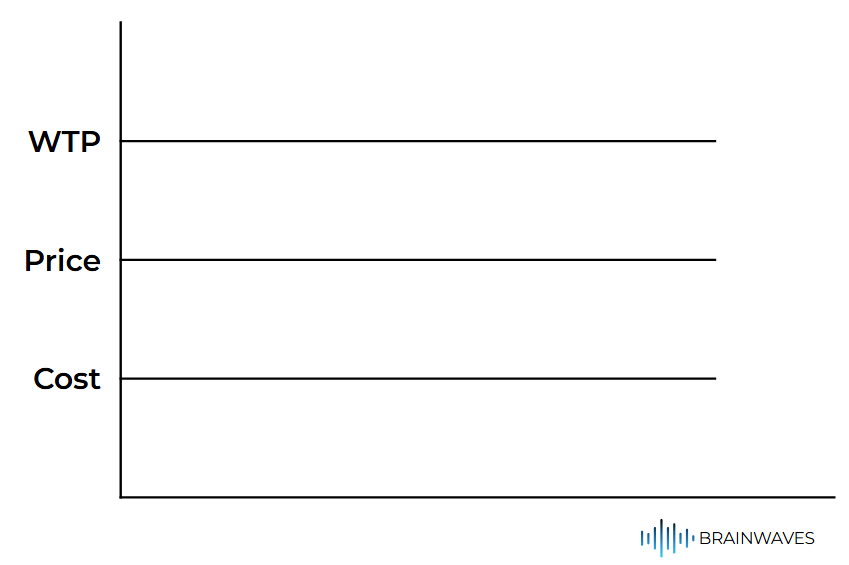
To be clear, in any functioning business, the following triad should always be true: price should be greater than or equal to cost, willingness to pay should be greater than or equal to price, and therefore, willingness to pay should be greater than or equal to cost.
The diagram below visualizes the above simply (for the visual learners):
Now that we’ve developed a basic understanding of the key terms, let’s dissect how they interact with each other (specifically referring to the differences between each term):
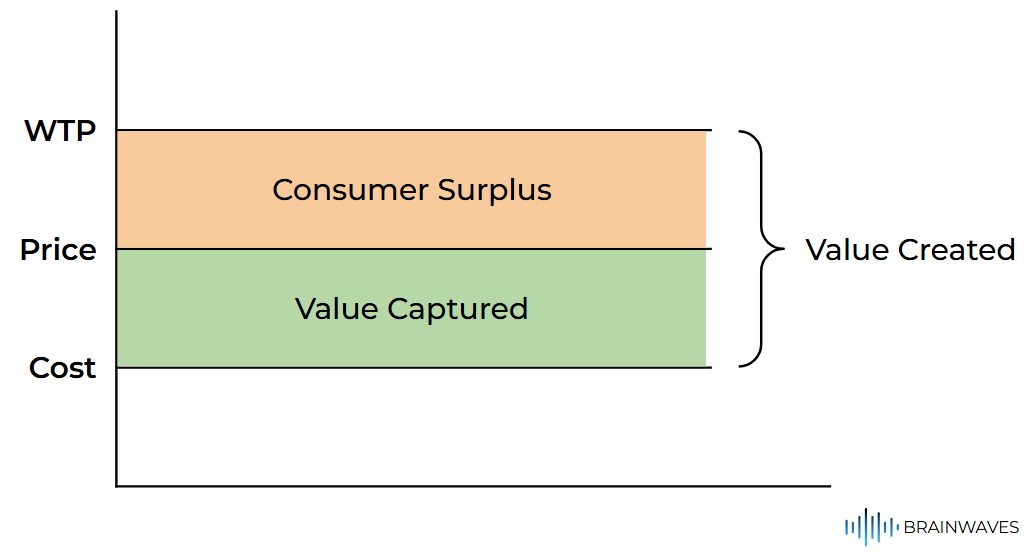
Value Created: The total value created through the transaction, a combination of value for consumers and for businesses (value created = WTP - cost).
Value Captured: Also referred to as profit, it is the amount of value created that the business captures as profit (remember, profit = price - cost).
Consumer Surplus: Consumer surplus is the additional benefits the consumer receives from a product or service beyond the price the consumer paid (consumer surplus = WTP - price).
For the visual learners out there, here’s how these additional terms fit into our framework:
Where does value come from (i.e., how is the value created)?
Referring back to our definition of customer value above, value creation is the process of generating the benefits that a customer receives/perceives from a product or service. This creation happens when a business transforms resources and inputs into a product or service that addresses a customer’s problem, fulfills their need, or provides an experience they desire.
When a product or service effectively and efficiently solves a customer’s specific pain point, this creates value for the customer. For instance, a new parking software that makes it easier to find and pay for parking creates value by saving customers time, effort, and the significant mental toil of driving around in circles.
Similarly, offering features, functionality, or a level of quality superior to alternatives can create value for customers. This could include a car with better fuel efficiency, a clothing brand known for extreme durability, or a new protein blend with dramatically increased fiber content for consumers looking for both. Additionally, if the product or service is easy to obtain, use, or access, this creates value by reducing customer friction.
However, value isn’t always rational. It can come from the emotional connection a customer feels to a brand (e.g., a luxury brand’s prestige) or from the enjoyment they get from using a product (e.g., exploding water balloons everywhere in glee).
Bringing us back into the realm of our framework, value creation specifically refers to the total value created in a transaction, equal to the maximum the consumer would pay for a product or service minus the cost the business incurs to provide it.
How do each of the layers work together?
The key to business strategy here is to focus entirely on the basics.
That’s always been my favorite analogy about professional soccer players: even given their extensive talent repertoire, they spend a majority of their time perfecting the basics. Business strategy, in this context, isn’t any different.
To begin, costs are the easiest for people to understand. For every business whose goal is purely profit maximization, they should focus on eliminating unnecessary costs (and potentially even some necessary ones).
Unfortunately, willingness to pay and price are more difficult concepts to articulate, but the framework does provide some helpful constraints:
Businesses should seek to maximize value creation
Businesses should seek to maximize value capture
We’ve already discussed the ways in which businesses can create value, but why should they? Put simply, businesses should create value in order to capture a portion of it.
Capturing value (the segment referred to as price minus cost in our framework), for our simple discussion today, can be considered synonymous with the term “profit.” To be clear, businesses mainly capture value through price. In other words, businesses should increase the value they create to boost their profits.
We’ll handle the dynamics of this framework in the sections below, but for now, let’s just assume that when a business increases the value it creates, it can proportionately increase the value it captures.
For example, let’s assume John is hoping to purchase a new pair of pants. His only option on the market is Company A. Now, Company A’s cost per pair of pants is $5. Let’s assume, given the current quality of the pants and their other benefits, that John is willing to pay up to $20 per pair. Now, let’s assume that Company B sets the price per pair of pants at $10 each.
In this case, value creation would be $15 ($20 willingness to pay minus $5 cost), value capture would be $5 ($10 price minus $5 cost), and consumer surplus would be $10 ($20 willingness to pay minus $10 price).
Now, let’s assume the same underlying scenario one month later, except that the company buys a new machine that reduces the cost per pant to $4 and adds a more modern pattern to the front of the pants, raising John’s willingness to pay to $25 each, and as such, the company sets a new price of $12 each.
In this case, value creation would be $21 ($25 willingness to pay minus $4 cost), value capture would be $8 ($12 price minus $4 cost), and consumer surplus would be $13 ($25 willingness to pay minus $12 price).
As you can see, manipulating any of the base properties of our framework (price, cost, or WTP) influences the level of value creation, value capture, and consumer surplus.
To revert back to the basics, as discussed above, the value creation and value capture framework can be distilled down to the following 3 key components:
Businesses should minimize costs
Businesses should maximize price (while still maintaining customers)
Businesses should maximize customer willingness to pay
Why is consumer surplus important?
When faced with two products or services, consumers choose the one that provides the greatest consumer surplus. To refresh your memory, consumer surplus is the maximum benefit a consumer derives from a product or service minus the price the consumer pays for it.
For example, if the maximum a customer is willing to pay for a loaf of bread is $10 and there are two options on the table: (1) priced at $4, and (2) priced at $6, the associated consumer surplus for each option is $6 and $4, respectively. So, the consumer would pick option 1, the one that provides the most consumer surplus.
To give another example, if you were choosing what meal to eat tonight and your options were steak (priced $20, maximum willing to pay $30) and lasagna (priced $12, maximum willing to pay $20), which would you pick?
Let’s compare the consumer surplus each option provides. The steak, priced at $20 with a willingness to pay of $30, provides $10 in consumer surplus. The lasagna, priced at $12 with a willingness to pay of $20, provides $8 in consumer surplus. In this case, assuming you have a large amount of money, you would pick the steak.
How does this framework tell businesses what price to charge their customers?
Often, early startups don’t know what their product should be priced at. As such, their prices usually fluctuate until they find their place in the market. But where should that price be set?
Our framework gives an initial range for where price can be set: somewhere between willingness to pay and cost. Delving into the dynamics of consumer surplus provides a more complete answer.
As a reminder, consumers choose which product or service to buy based on the consumer surplus they receive. Thus, businesses need to satisfy two inequalities:
Price > Cost
Consumer Surplus of Your Product > Consumer Surplus of Your Competitor’s Products
For example, if your company has a cost of $5 for each product, your customers are willing to pay $50 for your product, your competitor’s price is $25, and your customer’s willingness to pay for your competitor’s product is $35, what should you charge for your product?
To satisfy our inequalities, let’s do some math. First, your price needs to be greater than your costs but less than the customer’s willingness to pay. Secondly, your consumer surplus must exceed your competitor’s. Adding in the background data provided to our inequalities, here’s where we get:
Price > $5
($50 - Price) > ($35 - $25)
Solving for the second inequality, you get $40 > Price. So, combining the two equations gets us the following: $40 > Price > $5.
And, just like that, businesses have a more defined range with which to price their products or services to attract customers.
What information do businesses and consumers need to know, given this framework thus far?
Referring back to the fundamentals discussed above, each one is (primarily) derived from one of the following: the customers or the business.
For example, each business is responsible for its own cost structure (to a point). Similarly, each business is responsible for setting the price of its products or services (to a point).
Conversely, consumers are responsible for defining their willingness to pay for each product, although businesses definitely assist in influencing the matter (through advertising and other methods).
To put it simply, businesses are responsible for costs and price in our framework, while consumers are responsible for willingness to pay.
Additionally, to reiterate:
To increase value created: increase WTP or decrease costs
To increase consumer surplus: increase WTP or decrease price
To increase value captured: increase price or decrease costs
How does quantity fit into this framework?
Up until this point, we’ve used this framework exclusively for analyzing individual products or services. The only additional component of this framework to add is the x-axis: quantity.
Here is the complete framework:
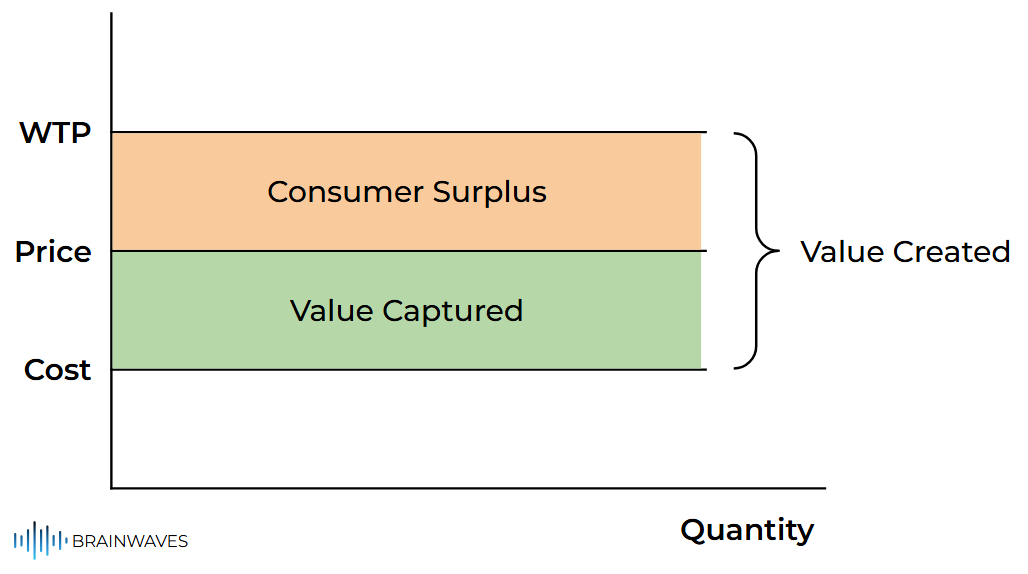
Quantity, or how far the cost, price, and WTP lines extend from the y-axis, indicates how many customers are purchasing a given product or service, as defined by this framework.
For example, how many people would purchase dog toys if each received a consumer surplus of $5? How many people would purchase dog toys if each received a consumer surplus of $10?
In this example, given our framework, we can assume that the number of customers for the consumer surplus example of $10 is greater than or equal to the number of customers for the consumer surplus example of $5.
Why? In the $10 scenario, any customer purchasing competing products and receiving less than $10 in consumer surplus from their purchase would be incentivized to be a customer (meaning everyone with a surplus of $9, $8, $7, $6, $5,...). In the $5 scenario, only those with a consumer surplus of $4, $3, $2, or $1 would be included. Therefore, if any consumers currently have a surplus of $6, $7, $8, or $9 in this market, they would be captured in the $10 scenario but not in the $5 scenario.
It’s simple supply and demand at work.
As such, we can begin to define some helpful notions by which a business can operate given this framework:
Changing the cost, leaving everything else the same, doesn’t influence quantity
Increasing the price, leaving everything else the same, decreases quantity
Decreasing the price, leaving everything else the same, increases quantity
Increasing WTP, leaving everything else the same, increases quantity
Decreasing WTP, leaving everything else the same, decreases quantity
In other words, increasing consumer surplus increases quantity, and vice versa. Decreasing the value captured increases the quantity, and vice versa.
What is this framework used for?
If you’re like me, when presented with a new framework or a new way of thinking (or when reading a highly technical paper), you skip directly to the application and conclusion section. This section discusses why this framework matters.
So far, we’ve discussed how this framework is critical to business strategy. How? It shows businesses how modulating basic factors (price, cost, and consumer WTP) influences key aspects of business success (the number of customers and the profit per customer).
This framework is also beneficial when thinking about competitive dynamics. For instance, businesses can leverage the framework to compare levels of consumer surplus offered in the market, estimate quantity levels, compare prices and their effects, and roughly estimate their competitors’ costs and profits.
Additionally, a business can project how changes in its basic factors will affect its operations and, more specifically, how it fares in the competitive landscape (given those changes). This is where the dynamics of the framework come into play, in the comparison and analysis of modulating different inputs and their effects on the outputs.
All of that from a basic framework with 4 key components (WTP, price, cost, and quantity).
P.S. This framework can be employed in a career choice context, as I discuss in Personnel Economics.
That’s a wrap on this deep dive.
Found this analysis valuable? The best way to support Brainwaves is to share it with someone who’d benefit from these insights.
Drew Jackson
Founder & Writer
Refer a Friend
Building this community has been one of the most rewarding parts of writing Brainwaves. If you know someone who’d enjoy these weekly deep dives, I’d love it if you could share your unique referral link with them. You’ll earn tangible rewards for growing our community, and they’ll get content worth their time. Win-win.
Keep Exploring
Next Deep Dive: Reincarnation - February 18th, 2026
This Saturday: Weekly roundup of breaking developments across energy, space, venture capital, economics, intellectual property, and philosophy
Previous Editions: View the archive here
Stay Connected
New to Brainwaves? Join hundreds of readers getting bi-weekly deep dives into the forces reshaping our world.
Sponsor This Newsletter: Reach an engaged audience of forward-thinking readers. Email us for details.
Disclaimer: Views expressed are personal opinions, not financial advice. This content is educational only. Investment decisions carry risks - always consult professionals and do your own research. All sponsorships are clearly disclosed.
© 2026 Brainwaves. All rights reserved.