


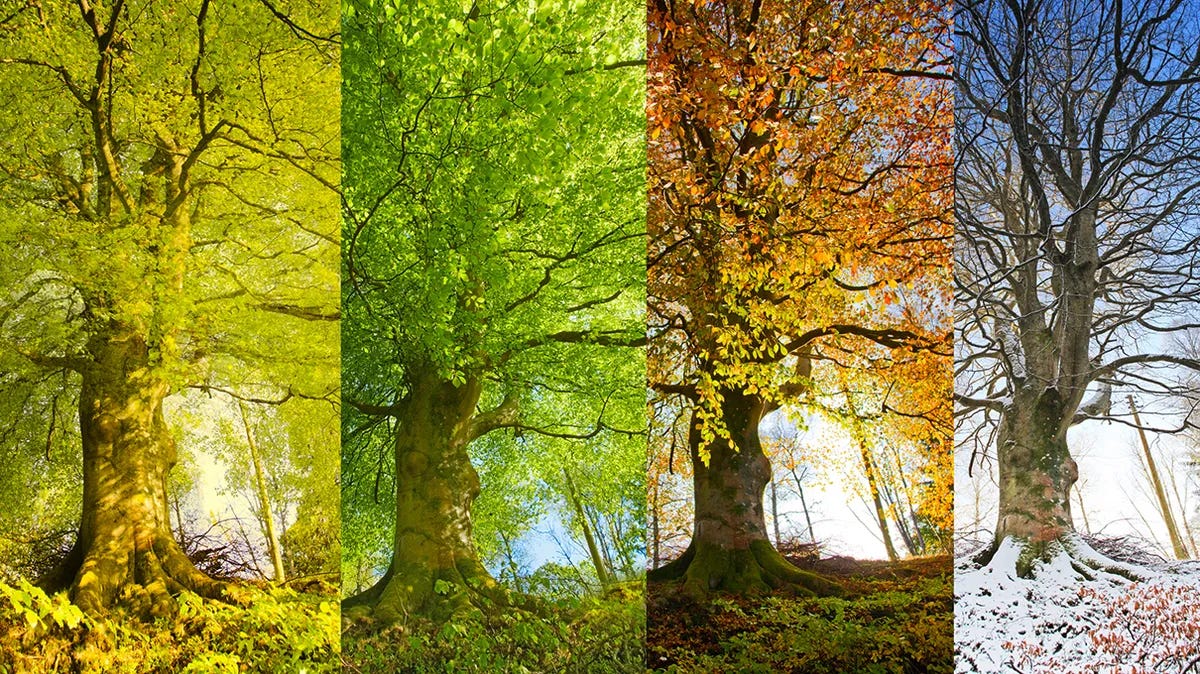
Credit HowStuffWorks
33% of Americans believe in reincarnation. In an era of data and logic, why is this ancient idea trending?
This Week’s Focus: Philosophy
What You’ll Understand: A concise, unbiased, modern perspective on reincarnation
Reading Time: 11 minutes for full analysis + key takeaways highlighted throughout
Key Question: How do modern people across the world think about, resonate with, and debate the topic of reincarnation?
My Take: The concept of reincarnation means radically different things to many people, with different emotional connotations (positive and negative) associated with each perspective. I’m not here to argue one side or the other—I haven’t even made up my mind on the topic. Reincarnation is a fascinating concept that majorly influences how some people live their lives. Maybe we’re missing something critical here?
Quick Context: New to Brainwaves? We explore the forces reshaping our world across venture capital, energy, space, economics, intellectual property, and philosophy. Subscribe here for bi-weekly deep dives plus weekly current events.
Refer a Friend - Earn These Rewards
Let’s dive in.
I don’t personally believe in reincarnation, yet. I don’t not believe in it either.
If I had to guess, based on my interactions with people in my circles, I would ballpark the percentage of people in the US who believe in reincarnation at <5%. Broadening that to the entire world, and I’d estimate around 20%.
What does the research say? A 2021 Pew Research Center study asked participants a variety of religious questions. One of those was whether they believed “people will be reborn again and again in this world.” Across all U.S. adults, the researchers found that 33% believe in reincarnation. That sure surprises me.
Broken out by specific demographics, 30% of Christians believe in reincarnation, 12% of atheists, 27% of men, 38% of women, 40% of young people (ages 18-29), 23% of older people (ages 65+), 28% of white people, 45% of black people, and 42% of hispanic people.
The demographic breakdown varies vastly depending on background, religious affiliation, age, race, and other characteristics.
What’s interesting to me, as a young person, is that we’re less likely to believe in heaven and hell, but apparently more likely to believe in reincarnation. Is there a subtle cultural shift here?
Broadening the data, a 2025 Pew Research Study found that across 35 countries surveyed, the median percentage of adults believing in reincarnation was 33%. Adults in sub-Saharan Africa, parts of the Asia-Pacific region, and Latin America were especially likely to believe in reincarnation, with Kenya achieving a whopping 66%. Most European countries were toward the bottom of the scale, while North American countries were solidly in the middle.
When this was broken down by religious affiliation, Buddhists and Hindus were most likely to believe in reincarnation, followed by Christians, Jews, the Religiously Unaffiliated, and then Muslims.
There were 10 countries with statistically significant differences between the youngest and oldest age groups, each showing a difference of 10+ percentage points between the oldest (who were less likely to believe in reincarnation) and the youngest (who were most likely to believe in reincarnation).
It seems like the phenomenon currently present in the US is actually part of a global trend. Why? What are people understanding that the rest of us don’t?
What sparked this discussion today was a brief comment buried in a long Reddit thread about what people realized as they got older. The first commenter answered, “That death is not the worst thing that can happen to me.” The next reply, and the crux of our conversation today, was “Reincarnation is.”
Someone, somewhere, thinks that reincarnation is worse than death. Why? The next comment in the chain provides a hint at the rationale: “This is really what starts frightening me more and more the older I get. I don’t understand how people can actually long for that. I am not ungrateful for my life, and I have been very lucky anyway. But the idea of having to do this over and over and over again—that’s a scary thought.”
Honestly, I can see where they’re coming from.
The younger you are, the longer life looks ahead of you. For instance, if you’re 5 years old, the next year of your life is equivalent to 20% of what you’ve lived thus far. If you’re 20, that’s just 5%, but if you’re 60, that’s only 1.6%. This is sometimes called the ratio effect, in which the change in proportion as you age can make life seem to pass more quickly.
Anecdotally, this tracks with our narrative thus far. Older people, who have lived longer and struggled through each and every day for the past 65+ years, are less likely to believe in reincarnation. Why?
There are a couple of reasons I can point to. Older generations in the U.S. and Europe grew up when traditional, institutional Christian faiths were more culturally dominant. Because religion played a more prominent role in earlier generations’ upbringing, these individuals have carried those beliefs and teachings into old age. Newer generations are less connected to institutional religion and more drawn to what is broadly termed “spirituality.” This category of belief is more inclusive of concepts like reincarnation, astrology, and spiritual energy.
Explanations of different religious upbringings and a broader cultural trend away from traditional religious adherence toward more personalized spiritual beliefs help account for why older people, especially in the U.S., are less likely to believe in reincarnation.
However, this doesn’t explain everything. Perhaps the most influential reason is that they’ve lived so long and, like our commenter above, they don’t want to keep doing that over and over.
The research specifically called out Buddhism and Hinduism for being much more likely to influence a belief in reincarnation, yet other religions still commanded significant percentages.
As we’ve seen, reincarnation is a central tenet of many Indian religions, such as Hinduism, Buddhism, Jainism, and Sikhism.
For Buddhists, the Buddha believed in an afterlife in another world and in reincarnation. The often misunderstood principle of karma influences rebirth and, most importantly, these cycles of repeated birth and death are endless. Every being reincarnates, creating the source of duhkha (which can be translated as suffering or pain), but this cycle can be stopped through achieving nirvana. Your past karma influences what you reincarnate as. As you would imagine, specifics differ between sects, but this description is a broad generalization of what most believe.
Hindus believe that the body dies, but not the soul, which is eternal. As in Buddhism, current karma affects the future in this life as well as future forms and lives. There is no permanent heaven or hell in most sects. In the afterlife, the soul is reborn as another being in either heaven, hell, or as a living being on Earth (human, animal, etc.). Once your karma runs out (in whichever place you are in), you’ll die and reincarnate. This cycle continues until you embark on a spiritual pursuit, gain self-knowledge, and attain moksa, which finally releases you from the cycle of reincarnation.
For the most part, mainstream Christianity doesn’t preach the tenets of reincarnation, so why do so many Christians believe in it? First, unlike some other religions, many forms of Christianity in the U.S. are highly decentralized, allowing for a wider range of interpretations of core teachings. Secondly, the concept of reincarnation was popular in the ancient world, particularly among Greek philosophers and early Christian groups such as the Gnostics and Cathars. These groups were ultimately deemed heretical, and their teachings were rejected; however, these ideas do have a historical connection to Christianity. Finally, some Christians who believe in reincarnation may not be fully aware of the theological incompatibility with mainstream Christian teachings.
No matter where you sit on the matter and what your background is, there are some intriguing insights to be gained by delving into the topic of reincarnation. For instance, one user on Reddit explains a unique viewpoint I hadn’t considered before:
Another thing people fail to realize is that if you believe in reincarnation, half of your belief already came true. Think about it for a second. You literally came to life. Reincarnation is the belief that it’s just simply going to happen again. So half of your belief has already come true. However, no one has actually been to heaven, hell, or experienced the void. So reincarnation comes the closest to actually being real because we’ve already experienced half of it.
In comparison to other viewpoints of the “afterlife” or “hereafter”, reincarnation viewed through this lens does offer some sense. It’s easy to look around us throughout our lives and see cycles (death and rebirth, sun and moon, weather, the seasons, etc.), so the ideas of reincarnation make more intuitive sense than some other fields of thought. However, just because it makes sense doesn’t mean it’s “true” (whatever meaning you describe to that word).
Another interesting perspective is offered by Bryce Haymond in a 2019 essay on the matter titled “The Mystical Resurrection or Reincarnation of the Ocean in Every Wave.” He writes:
I like to use the analogy of a wave in the ocean, as many others have used. The ego or individual is like the wave. The true Self is like the ocean. A wave arises in the ocean. It is unique in form, in shape, in size, in speed, in arrangement of its atoms, in its duration, etc. It has a host of qualities which are particular to its specific manifestation, and these endure as a kind of pattern through time.
But eventually the wave subsides back into the ocean, or crashes on the beach. It comes to an end, a total, complete, thorough, absolute end. That particular wave will never rise again. Ever. In all eternity. It was unique in itself, a unique manifestation of the ocean, with all its particular qualities. It will never be repeated. Ever. That is not what repeats.
The ocean will wave again. Another wave will arise in the ocean, with a different set of qualities, a different but similar form, shape, size, speed, arrangement of atoms, duration, which are all particular to its specific manifestation, and these will endure through time until it comes to its end.
What these waves do not know is that they were not merely unique waves, they were the ocean. If they had minds, they might be quite fearful of their dissolution on the beach, fearing that they may never rise again. But they have forgotten that they are really the ocean. Did the ocean cease to be when the wave subsided or crashed on the shore? Not at all. And it will rise again in new waves, each one unique and particular in itself, but never a repeat of a previous one. Each and every one will be a new unique manifestation of the ocean. It is the ocean that endures through innumerable lifetimes of waves.
When we realize we are not merely the wave, but the ocean, we have in essence been “resurrected,” realizing we are the “reincarnation” of the Divine, because we now know our true eternal identity, that which has arisen as all prior forms/beings, and that which will arise again in all future forms/beings, eternally.
In his perspective, there’s this centralized “form” that we all reincarnate into and from, and, as such, we become similar but unique versions of ourselves, all stemming from the original source. It’s a complicated concept, but it might have resonated with you given your personal experiences or upbringing.
Lastly, the final perspective I want to present was articulated by Thomas Ryan in 2015. In the article, he discusses the differences between Eastern and Western views of reincarnation.
In Hinduism, for example, the cycle of rebirth is generally a fearful thing referred to as the “wheel of karma.” The wheel is tied to notions of guilt and punishment and evokes fright; it’s something people want to be liberated from as soon as possible.
But among North Americans and western Europeans, reincarnation is often given a very different spin: it represents new and positive opportunity. It’s not a burden but a comfort positively associated with new possibilities for self-fulfillment. Not surprisingly, perhaps, it is a reflection of our modern “buffet” approach to life—the more variety and diversity I can have, the tastier and more interesting this “meal” will be! So the prospect of being able to come back to the table of life without limit is a positive one.
In essence, there are at least two potential mindsets with which reincarnation can be addressed. The first is how our commenter above treats it: primarily as a burden, a fearful occurrence of endless reincarnation. The second is how some in the West may be approaching it: seeing the positives and recognizing it as an opportunity to continuously learn and improve over time.
Long story short, the goal of this essay isn’t to convince you one way or another. I don’t think I’ve even convinced myself one way or the other. It’s primarily to showcase that there’s probably a large dialogue concerning reincarnation that we’re not considering in our lives for many reasons.
For me, I haven’t spent a lot of time with it because I haven’t had many people around me who have died, so I haven’t needed to consider what’s happening to them after they die. I’m also young and haven’t considered what’s next for me because there’s still so much here now for me.
I’ve brought up a couple of intriguing perspectives and resources so far, but there are thousands more if you’re interested in diving deeper into this subject. We don’t necessarily need every answer now, but it’s good to know a little more about what we don’t know.
To conclude, there are many different views on reincarnation throughout history. There’s no consensus across the U.S. or even across the world today. There are convincing arguments on both sides of the aisle. You may be like me, stuck solidly in the middle, or you might be on one side or the other.
Ultimately, whatever works best for you is what you should pursue. Maybe you’re like me and haven’t fully considered where you stand. In contrast, you might know exactly what you’re looking for and where you are. Either way, continue learning, stay curious, and remember you might not know everything—you might find you resonate with things you’ve never considered before.
That’s a wrap on this deep dive.
Found this analysis valuable? The best way to support Brainwaves is to share it with someone who’d benefit from these insights.
Drew Jackson
Founder & Writer
Refer a Friend
Building this community has been one of the most rewarding parts of writing Brainwaves. If you know someone who’d enjoy these weekly deep dives, I’d love it if you could share your unique referral link with them. You’ll earn tangible rewards for growing our community, and they’ll get content worth their time. Win-win.
Keep Exploring
Next Deep Dive: The Circular Economy - March 4th, 2026
This Saturday: Weekly roundup of breaking developments across energy, space, venture capital, economics, intellectual property, and philosophy
Previous Editions: View the archive here
Stay Connected
New to Brainwaves? Join hundreds of readers getting bi-weekly deep dives into the forces reshaping our world.
Sponsor This Newsletter: Reach an engaged audience of forward-thinking readers. Email us for details.
Disclaimer: Views expressed are personal opinions, not financial advice. This content is educational only. Investment decisions carry risks - always consult professionals and do your own research. All sponsorships are clearly disclosed.
© 2026 Brainwaves. All rights reserved.