



Credit Southern Cross
Carrots and sticks compel governments, businesses, and consumers to transition to clean energy, but is the current system enough?
Reading Time: 12 minutes for full analysis + key takeaways highlighted throughout
Key Question: How are people incentivized to transition to clean energy?
My Take: Transitioning to clean energy is driven by a powerful mix of carrots (positive incentives such as tax breaks and cost savings) and sticks (negative incentives such as carbon taxes and reputational risk). Often, the sticks are more powerful than the carrots, but this varies by sector.
Refer a Friend - Earn These Rewards
Let’s dive in.
As solar, wind, geothermal, and other clean energy sources entered the mainstream in the early 2000s and gained momentum in the 2010s, the main push was to “save the environment.” Major news networks consistently ran studies showing how fossil fuels were destroying our planet and that it was everyone’s responsibility to make a change. For example, a 2010 article by NASA concluded with the following:
Ultimately, global warming will impact life on Earth in many ways, but the extent of the change is largely up to us. Scientists have shown that human emissions of greenhouse gases are pushing global temperatures up, and many aspects of climate are responding to the warming in the way that scientists predicted they would. This offers hope. Since people are causing global warming, people can mitigate global warming, if they act in time. Greenhouse gases are long-lived, so the planet will continue to warm and changes will continue to happen far into the future, but the degree to which global warming changes life on Earth depends on our decisions now.
Consumers were pushed to install solar panels on their homes, switch to electric vehicles, and recycle every last piece of plastic, paper, glass, and metal products. Consumers pushed businesses to adopt clean energy, recycling, and green sourcing processes. Governments pushed consumers and businesses to change, often driven by scientific pressure, geopolitical concerns, and international agreements.
Why should they change? At the most basic level: for the greater good—the survival of all, the thriving of the forests, the clean air, the environmental ramifications.
For some, that was enough incentive to change their behavior. For many others, however, they needed more incentives.
Now in 2026, the clean energy transition is no longer just an environmental crusade—it’s evolved into an economic and geopolitical chess match.
National Security & Economic Prosperity
Arguably, the entities most affected by the clean energy transition (or lack thereof) are countries.
For nations, the clean energy transition often boils down to creating domestic energy sources, which is becoming increasingly critical to national security and economic dominance.
This is one of the most important incentives driving the clean energy transition. As the recent closure of the Strait of Hormuz showed, many countries remain heavily dependent on fossil fuels and can be crippled by supply cutoffs due to geopolitical issues.
Thus, in these scenarios, energy security from domestic sources is crucial—whether from clean sources, domestic fossil fuel supplies, nuclear energy, or other domestic energy sources. In other words, this solution isn’t entirely proprietary to clean energy; it applies to any energy source that can be supplied domestically. Many countries lack domestic supplies of many fossil fuels or other energy sources, but almost all have sun and wind to leverage.
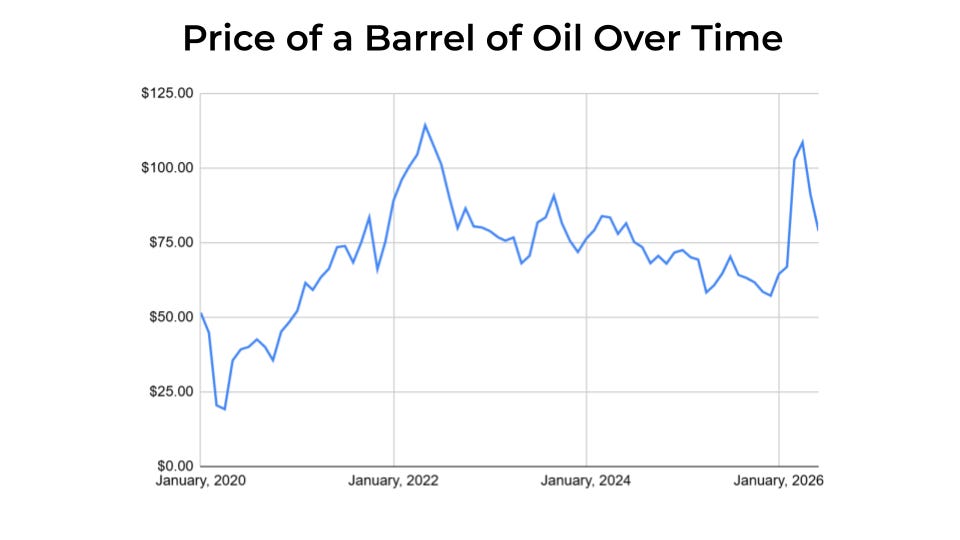
Credit MacroTrends
As we’ve seen through the Iran war conflict, the price of a barrel of oil (shown in the graph above) has risen dramatically, creating tension in countries that lack true energy independence through supply chain issues and price spikes.
Beyond national security concerns, building infrastructure for new energy sources creates massive job growth in manufacturing, logistics, infrastructure, and technology development. This keeps funding in-country, bolsters the energy grid, and provides income for families across the region.
For example, the Department of Energy in 2024 cited that jobs in the clean energy sector grew at more than twice the rate of overall U.S. employment. Jobs in clean energy grew by 4.2%, more than twice the overall economy’s job growth rate of 2.0%.
On the flip side, countries have been forced to transition to clean energy because they face heavy tariffs or potential trade penalties from trading partners if they don’t decarbonize domestic goods.
And, most importantly, countries and their citizens must pay ever-increasing bills for the destruction caused by extreme weather events. The National Centers for Environmental Information report that since 1980, there have been 403 weather events with over $1B in losses in the United States, averaging 9 events per year, with the average over the last 5 years at an astonishing 23.
This demonstrates a worrying trend: unmitigated climate effects are causing disproportionate harm compared to the costs of mitigation. Governments must drive and even impose change at a national level to have any true effect; simply waiting for individuals and businesses to change will not create the urgency necessary to succeed and prevent further impacts.
ESG & Consumer Preferences
Over the last decade, a new term has emerged in business: “ESG.” As I wrote two years ago, consumers, employees, and regulators are increasingly demanding that companies be good stewards of natural and social capital and have the governance in place to support these efforts.
In many ways, sustainability is now an unofficial fiduciary duty.
Some of the most important economic minds have weighed in on this topic over time, most notably Nobel laureate Milton Friedman. In Friedman’s viewpoint, a corporation’s sole responsibility is to increase profits for its shareholders. Thus, using funds for social causes or efforts unrelated to profitability is a reckless, negligent act for a manager and effectively amounts to spending other people’s money without their consent. Why should corporate executives be the ones to decide what is socially responsible? Instead, if profit is maximized, each shareholder will have more money to give to these causes, potentially providing a larger total benefit to the “best” causes.
In contrast, many modern economists argue that corporations cannot operate in a vacuum and must account for all stakeholders—including employees, customers, suppliers, and local communities. The rationale is that companies create social and environmental externalities, such as pollution, and thus should bear responsibility for mitigating these impacts rather than offloading the costs to society.
To my knowledge, there hasn’t been a conclusive answer on this subject, although one of the leading perspectives (the middle camp) I’ve seen is a modified version of the Friedman position, arguing that corporations should be socially and environmentally responsible to the extent it helps them maximize profits—any further should not be pursued, as it detracts from the maximization of profit.
This is an important issue because it dramatically affects companies’ perceptions of the external environment. For example, a key concern for many workers evaluating companies as potential employers is their stance on ESG issues and how much they promote and integrate ESG into their business operations.
Beyond ESG concerns, companies face many other incentives and disincentives to transition to clean energy. For instance, many governments offer lucrative tax credits and grants to help companies green their operations.
From an operational cost standpoint, businesses are facing difficult decisions on every front, especially in the United States, as supply chain uncertainties and inflation abound. Luckily, in 2026, solar and wind are now the cheapest forms of new electricity in most of the world, leading to cheaper corporate power purchase agreements, with some corporations choosing to build and own clean energy infrastructure rather than buy from grid operators.
This directly impacts the bottom line, creating an incentive structure that employees, customers, and shareholders can support while protecting the environment and the planet’s resources.
Negative incentives also push companies to transition to clean energy. In many countries, companies face strict carbon taxes, emissions caps, and mandatory climate disclosure laws. Corporations that don’t pursue ESG and/or clean energy transitions risk consumer boycotts and greenwashing lawsuits that damage brand equity.
Given rising energy costs, oil companies and other infrastructure-oriented and -reliant companies risk being left with billions of dollars in fossil-fuel and legacy energy infrastructure that will become obsolete and worthless before it pays for itself. As a result, many are decreasing or entirely halting development of new fossil-fuel infrastructure.
Financial Incentives & Infrastructure Upgrades
Over the last decade, perhaps the group most relentlessly pushed to transition to clean energy was everyday individuals.
Consumers were promised that home values would increase by more than the cost of the solar panels and installation, and that their monthly energy bills would be significantly reduced. Opendoor estimates that solar panels typically add 3-4% to a home’s sale price nationally, a medium premium of around $15k (often less than the true cost of the panels).
Given recent geopolitical and other economic factors, third-party energy costs have steadily increased. Luckily, those who proactively installed rooftop solar and home batteries have been insulated from these rising grid electricity prices. In 2023, more than 1 in 5 new residential solar systems included batteries, and that share is climbing rapidly.
For individual consumers, vehicles and transportation have historically been among the largest CO2 emitters. Luckily, governments have been pushing large-scale electric vehicle point-of-sale discounts and tax credits.
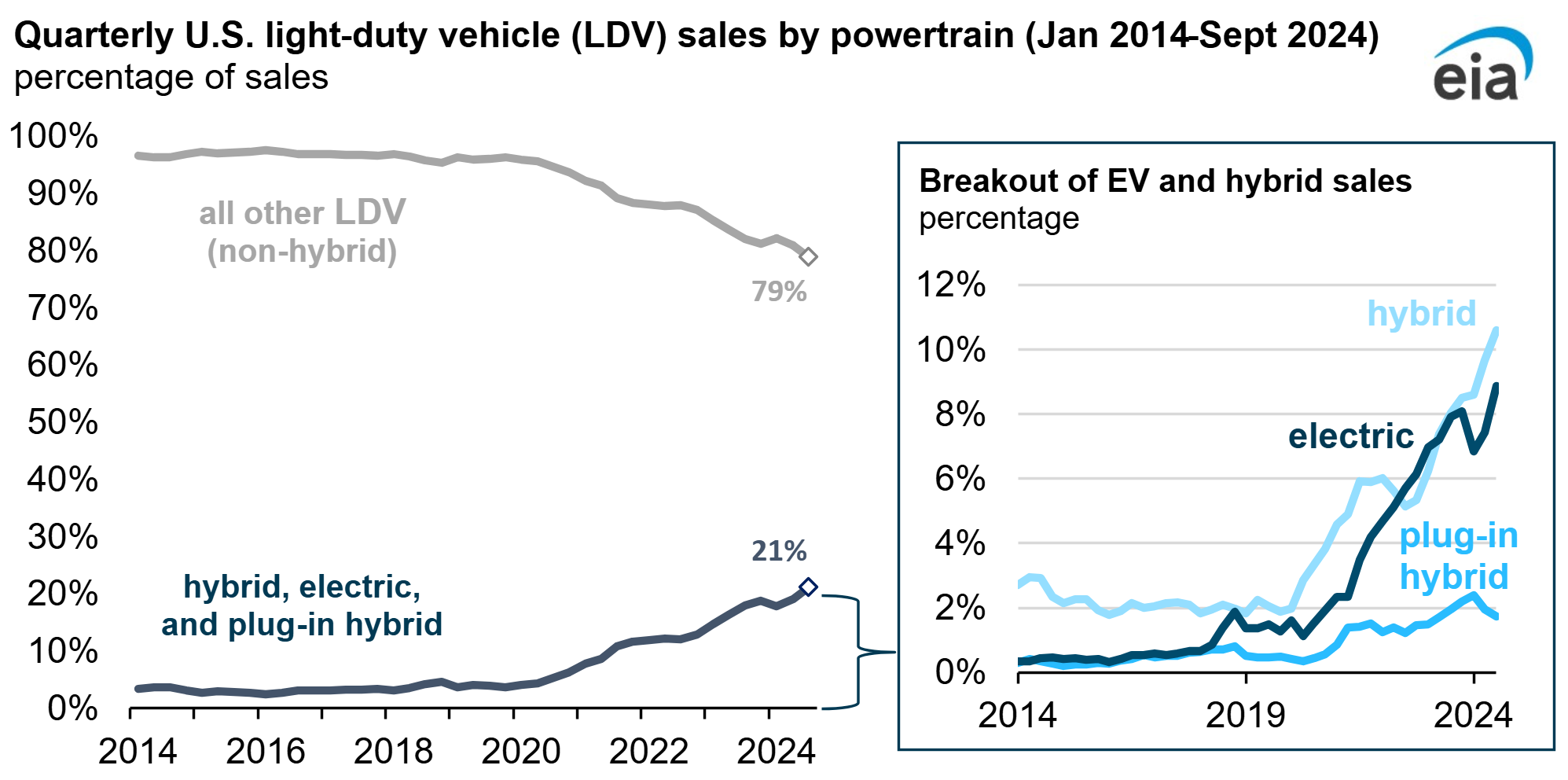
Credit EIA
As you can see on the graph above, the share of electric and hybrid vehicles has steadily increased as a share of total cars on the road; there is still much market share to gain over time.
It hasn’t been all sunshine and rainbows. Especially over the last few years, consumers in the United States have faced rising inflation across all product categories. Perhaps an overlooked cost has been the dramatic increase in energy costs in addition to physical products. Over the last 5 years, energy costs have increased by ~50%.
This has resulted from rising gas and heating oil costs as governments phase out fossil fuel subsidies, infrastructure continues to age, and supply has been further constrained beyond OPEC thresholds.
On a larger scale, traditional gas cars and inefficient homes, as they become increasingly outdated and face rising refurbishment and/or operating costs, are losing market value faster than other “cleaner” peer assets.
More Incentives Are Needed to Enact Short-Term Change
Ultimately, the clean energy transition has fundamentally outgrown its original identity as a purely altruistic environmental crusade. What began as a plea to “save the planet” has evolved into a reality driving global economics, national security strategy, and consumer financial decisions.
As we’ve seen over the last decade, the effects of climate change continue to compound, leaving a deadly trail of destruction, casualties, disease, drought, and more. Governments continue to urge their citizens and businesses to change, to no avail. Some countries, businesses, and consumers remain in deep denial about these changes, undermining global initiatives and muddying the political waters.
Today, the world faces a cost of inaction. Often, decision-making doesn’t factor in that cost. Without the threat of climate change, we wouldn’t be moving toward green energy sources even 10% as fast as we are currently. To shape our future, green energy sources must address economic challenges, which is only possible through innovation and public policy.
Luckily, all hope is not lost. Renewable energy accounted for ~32% of global electricity generation in 2024. Already, 10 countries are fully renewable-based, with another 11 over 90%. As seen above, electric vehicles account for around 21% of all cars in the United States, are rapidly growing in market share, and are projected to become the majority in the near future.
For many, the incentives currently in place are enough to inspire long-term change. However, to ensure mass change across the entire world in the short term, on the scale necessary to stall and reverse the effects of climate change, more and larger incentives need to be created. Generally, people move twice as fast away from pain as they do towards gain.
That’s a wrap on this deep dive.
Drew Jackson
Founder & Writer
Found this analysis valuable? The best way to support Brainwaves is to share it with someone who’d benefit from these insights.
Refer a Friend
Building this community has been one of the most rewarding parts of writing Brainwaves. If you know someone who’d enjoy these weekly deep dives, I’d love it if you could share your unique referral link. You’ll earn tangible rewards for growing our community, and they’ll get content worth their time. Win-win.
Keep Exploring
Next Deep Dive: When Will Humans Next Be On the Moon - Sept 2nd, 2026
This Saturday: Weekly roundup of breaking developments across energy, space, venture capital, economics, intellectual property, and philosophy
Previous Editions: View the archive here
New to Brainwaves? Join hundreds of readers getting bi-weekly deep dives into the forces reshaping our world.
Sponsor This Newsletter: Reach an engaged audience of forward-thinking readers. Email us for details.
Disclaimer: Views expressed are personal opinions, not financial advice. This content is educational only. Investment decisions carry risks - always consult professionals and do your own research. All sponsorships are clearly disclosed.
© 2026 Brainwaves. All rights reserved.