



Credit Gregg Vanourek
We’re paying the price for aggressive consumption. Can a circular architecture save our economic and ecological future?
This Week’s Focus: Energy & Environment
What You’ll Understand: The benefits and drawbacks of the circular economy transition
Reading Time: 12 minutes for full analysis + key takeaways highlighted throughout
Key Question: Should we incentivize and encourage a shift to a circular economy?
My Take: The circular economy entails high costs—redesigning every process to promote sustainability, reduce waste, and promote mindful resource use. It won’t be easy, but it’s necessary to address climate change, reduce waste, and build a better future for generations to come. Our current mindsets of aggressive production and consumption aren’t healthy, and we’re beginning to pay the price.
Quick Context: This deep dive connects to my past work on recycling and recent news in The Saturday Morning Newsletter #75. New to Brainwaves? We explore the forces reshaping our world across venture capital, energy, space, economics, intellectual property, and philosophy. Subscribe here for bi-weekly deep dives plus weekly current events.
Let’s dive in.
Growing up, I didn’t have many conscious experiences with the circular economy.
Unbeknownst to me, it was surrounding me and affecting many aspects of my life.
For instance, I learned about the three-step approach of reduce, reuse, and recycle in school. But our community didn’t have a large-scale recycling program, so my first experiences with recycling were occasional in college, and now it’s a constant since I’ve moved to Seattle.
During a semester in college, I interned with the Department of Entrepreneurship at Penn State as a research assistant. One of the primary initiatives was to investigate the next generation of nuclear reactors, including micro nuclear reactors, Gen IV and V reactors, and medical byproduct uses.
This research generated my significant interest in the nuclear, energy, and environmental sectors. Now, I may not have grown up with the circular economy, but I’m trying to be a better participant in it. My next step is to learn more about the circular economy and teach you as much as I can.
The Circular Economy
Since the beginning of time, and especially since the dawn of the Industrial Revolution, humans have operated primarily on a traditional, linear economy.
The traditional model (visualized below) treats resources as infinite and assumes humans can dispose of waste cheaply.
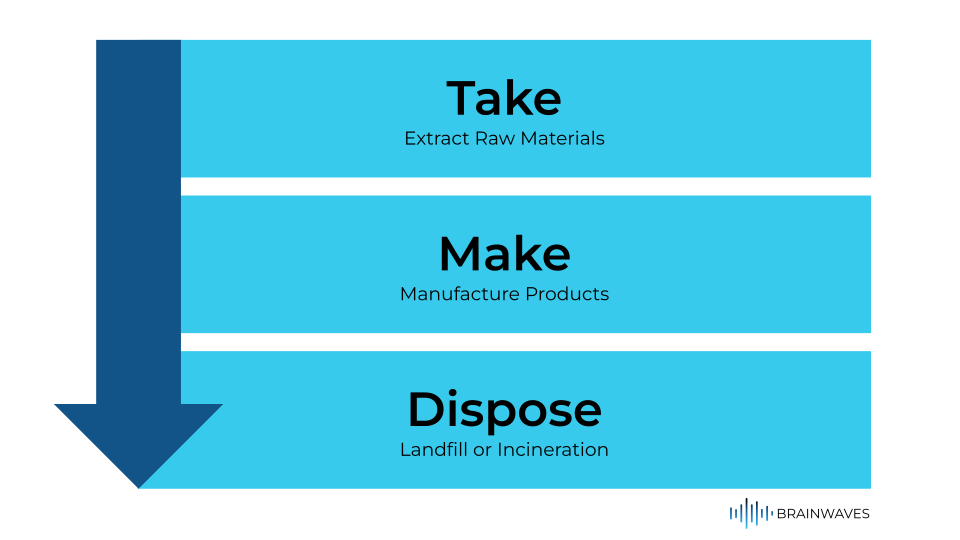
This approach results in significant resource depletion, environmental damage, and massive waste.
I’ve seen direct examples of this in my life: products aren’t used to their full potential. They are sent directly to waste when they’re no longer in use, even if they still have useful life left or contain recyclable materials.
The Industrial Revolution brought exponential change worldwide and laid the groundwork for the new, linear economy. As industries expanded and technologies advanced, many countries’ economies grew, and goods were mass-produced on a scale unprecedented before (e.g., the Henry Ford production line). At the time, people treated resources as relatively infinite and therefore abused and degraded the Earth in pursuit of economic gain.
Over time, subsequent generations have learned to do this more effectively, creating even larger quantities of more advanced products. But the underlying model hasn’t changed—we still take, make, and dispose.
The adverse effects of this approach, while always present, are beginning to manifest: environmental damage, shortages of key materials, rapid accumulation of waste, and other consequences.
The introduction of the circular economy shifts this paradigm, focusing on designing products and systems for longevity, reuse, repair, and eventually, regeneration. It seeks to maximize the utility and value of products, components, and materials by keeping them in circulation for as long as possible. In an ideal world, the circular economy will prevent waste from being produced in the first place.
The following is an in-depth analysis of the circular economy, including:
The Butterfly Diagram
Aspects, Principles, & Strategies of the Circular Economy
The ‘How’ and ‘Why’ Behind the Transition to the Circular Economy
The Next Era of Circular Economies
The Butterfly Diagram
Often, new topics are best learned through visualization—especially those as complex as the circular economy. The Ellen MacArthur Foundation created what they call the “butterfly diagram,” which showcases the circular economy to help people better understand its mission and goals:
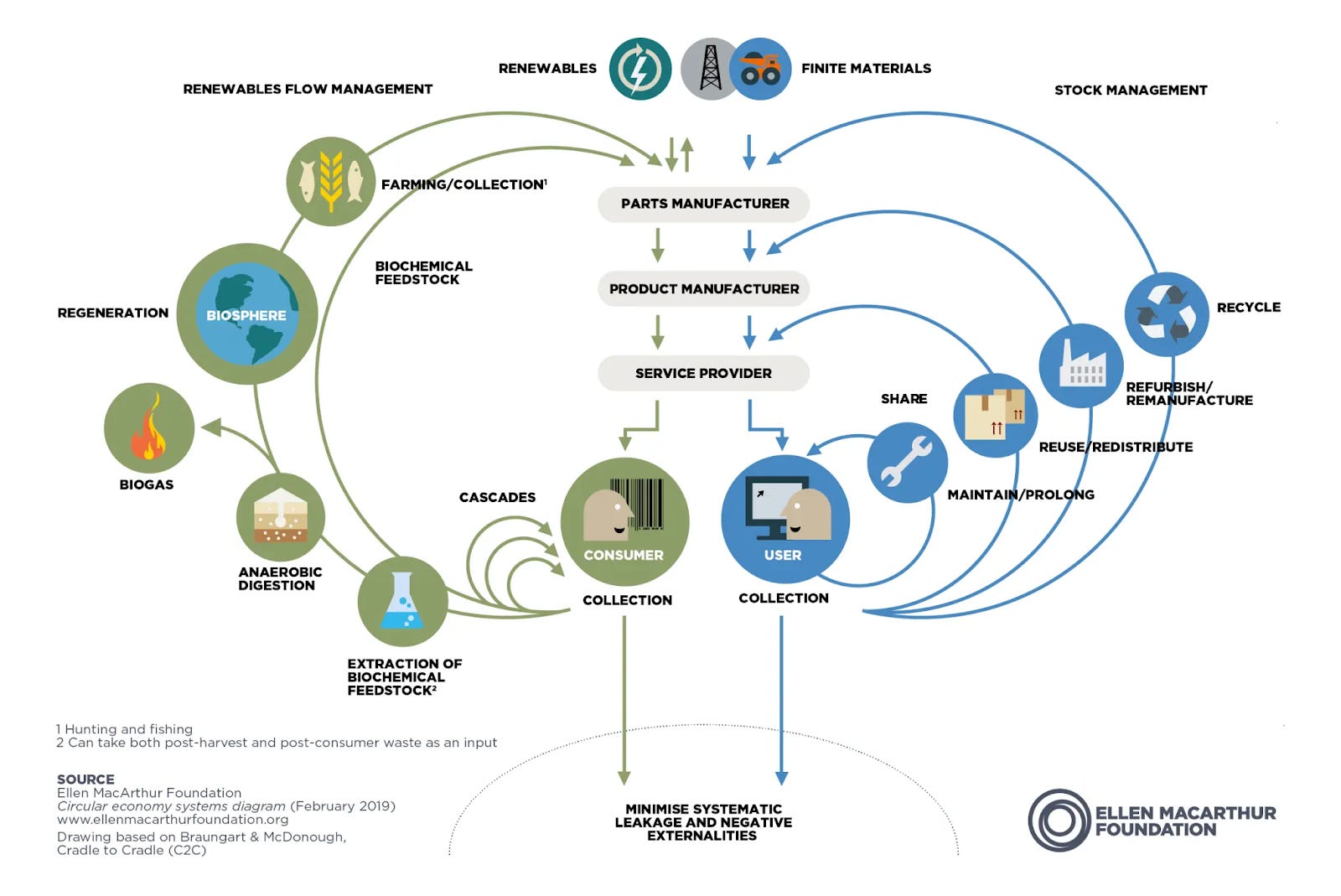
There are two sides to the cycle, the biological portion (left) and the technical portion (right). As writers at the Ellen MacArthur Foundation explain:
On the left-hand side of the butterfly diagram is the biological cycle, which is for materials that can biodegrade and safely return to the earth. This cycle mainly concerns products that are consumed, such as food. However some other biodegradable materials, such as cotton or wood, may eventually make their way from the technical cycle into the biological cycle once they have degraded to a point where they can no longer be used to make new products.
One of the key concepts in this section is regeneration. In contrast to the linear economy, which is primarily built on the continuous exploitation of natural resources without refilling the top of the funnel, regeneration prioritizes end products that can also serve as starting materials. If we design with the end (and subsequent recycling and a new beginning) in mind from the outset, we can sustain our consumption habits almost indefinitely.
The goal is to create a feedback loop with cascading effects. This loop would use existing products and materials in a continuous cycle. When products are eventually degraded beyond the point of return, they are returned to the soil and ultimately decompose into raw materials.
The technical cycle describes the actions taken in the biological cycle. There are many layers that sustain the use and implementation of products throughout this cycle to optimize resource value and availability before true degradation.
For instance, the innermost ring of sharing can significantly increase the utilization of many products. As writers at the Ellen MacArthur Foundation cite, “You may have heard the stat: the average power drill is used for just 13 minutes in its entire life. That is shocking underutilisation – and yet still many of us own one. Why not share?” Sharing does not apply only to drills—it can apply to many underutilized products worldwide.
At the other end of the spectrum is recycling. It’s the last resort in the circular economy (and also in the reduce, reuse, recycle trilogy). It entails forfeiting the product’s accumulated value by reducing it to its raw ingredients. While it isn’t the primary goal, products should be designed for recycling—especially any items that aren’t applicable in the prior steps of the technical cycle.
Credit Allianz
Aspects, Principles, & Strategies of the Circular Economy
You should be familiar with the famous triad, “Reduce, Reuse, Recycle.” Often, we focus only on the last one; however, someone recently pointed out that it’s actually the last action we should pursue, as reducing and reusing are far more effective.
In fact, this triad is only a small part of a broader framework developed by proponents of the circular economy, known as the R-Strategies (R-Ladder). The framework provides the most effective strategies for transitioning society from a linear to a circular economy.
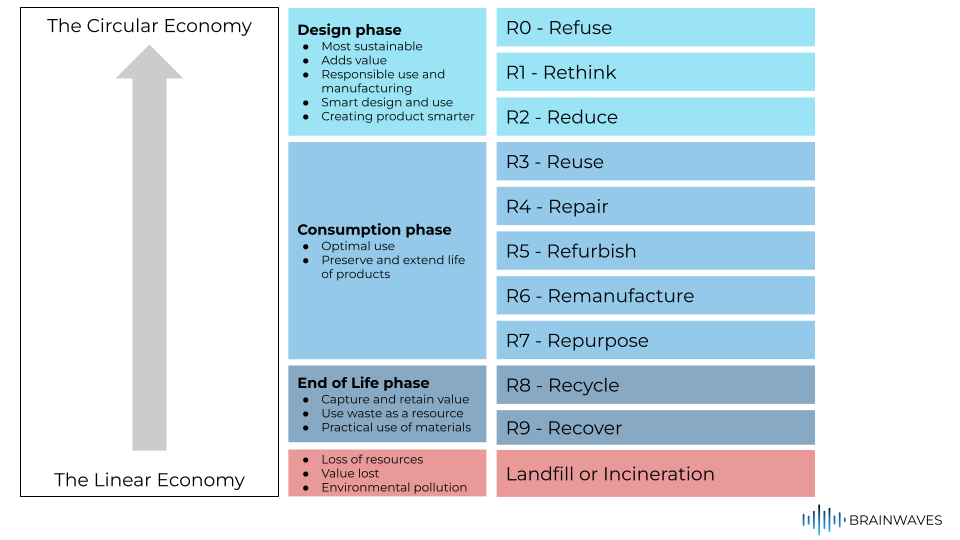
It’s a complex diagram, but it ultimately reduces to 3 main activities that promote a linear economy.
The design phase is characterized by more efficient use of products and manufacturing processes. We need to refuse, thereby preventing the use of products, services, or raw materials to create unnecessary or inefficient end products. We can rethink the ownership, use, and maintenance of each product before discarding it. Finally, we should reduce the use of raw materials to prevent waste or underutilization.
The goal of the consumption phase is to extend the possibilities and lifespan of products already in use. We can reuse products (usually from another owner), repair broken products to working condition, refurbish and restore them to their original working status, remanufacture the same products using discarded portions or spare parts, and repurpose them to make new products from discarded products or parts.
Finally, if we have not yet reduced waste through the aforementioned steps, the end-of-life phase still offers a solution. We can recycle products by processing waste into new materials (e.g., plastics and glass) that can be used to produce new products. Or we can recover energy from waste processing to help offset the cycle’s costs.
If none of these are accomplished—or, more likely, if humans don’t know they are an option or don’t have habits to choose them, or simply are lazy, these products end up in a landfill or are incinerated. No value can be repurposed; the linear economy persists.
There are 9 steps that can capture some value from materials or products before everything is lost, with the level of capture increasing as you go higher up the ladder. In the linear economy, new raw materials are continuously needed, and waste increases accordingly. In a circular economy, using the R Ladder, we ensure that products and materials retain their value and waste is critically limited.
This ladder provides a structured approach to using resources more efficiently and making the resource economy circular. Companies, consumers, government, and all other entities play a crucial role in this transition.

Credit Phys.org
The ‘How’ and ‘Why’ Behind the Transition to the Circular Economy
Transitioning to a more circular world requires fundamental system change. As the World Economic Forum explains, “Consumers, businesses and politicians all need to make changes to how goods are designed, produced, sold, manufactured and reused.”
For instance, the circular economy will require designing products more intelligently, so they can be easily reused, repurposed, and recycled. Companies are seeking technology solutions that enable the production of materials with reduced reliance on raw materials, lower input costs, and lower energy consumption.
Recent advances in the sharing economy, through services such as Uber and Turo and new product-as-a-service business models, integrate sustainability, reusability, and resource allocation optimization.
Good intentions from consumers and businesses are a start, but fundamental policy shifts are necessary to further incentivize and mandate change over the long term. Over the last decade, countries have enacted laws banning gas-powered vehicles, single-use plastics, and other environmentally harmful products, in an effort to shift consumer demand and corporate resources toward circular solutions.
Is this all for nothing? Why are entities around the globe pushing so hard for this initiative?
As the Ellen MacArthur Foundation writes, “The circular economy tackles climate change and other global challenges, like biodiversity loss, waste, and pollution, by decoupling economic activity from the consumption of finite resources.”
Transitioning to a truly circular economy offers numerous environmental benefits, primarily through the conservation and responsible use of natural resources. Resource extraction and raw material processing are highly energy-intensive, generating substantial CO2 emissions. By giving products a second use or recycling them, we dramatically reduce our energy demand.
To add data, the World Resources Institute estimates that transitioning to a circular economy could reduce global greenhouse gas emissions by 39%. This switch could significantly impact climate change mitigation efforts, driving change worldwide.
The circular economy creates a resilient system that delivers immediate economic efficiency and resource security for current generations while preserving the natural capital and environmental health necessary for future generations’ prosperity.
Opponents of the circular economy have raised concerns that the transition to it will reduce productivity. As you might imagine, reduced productivity can signal serious trouble. They argue that to reduce the massive waste our society produces, we must drastically slow emissions-heavy productive activity.
Proponents like the Forest Stewardship Council disagree, citing the financial benefits of the circular economy. Businesses can reduce costs by minimizing waste, particularly waste disposal fees, thereby improving profit margins. Circular estimates indicate businesses could save up to 70% on waste-disposal costs by adopting circular practices.
The United Nations Assistant Secretary-General estimates that a transition to the circular economy could deliver $4.5T in global economic benefits by 2030. Since 2019, an estimated $350B in financing and investment has been deployed to transition to the circular economy by entities seeking to capture a share of that $4.5T.
There is an extensive list of pros and cons associated with the transition to a circular economy. Advantages cited include resource efficiency, economic growth and job creation, environmental protection, increased sustainability, and higher societal resilience. Disadvantages cited include initial costs, technological dependency, regulatory challenges, short-term market disruptions, and a substantial shift in consumer behavior.
Credit The World Economic Forum
The Next Era of Circular Economies
The circular economy constitutes a comprehensive, systemic shift as we transition from a “take-make-dispose” model to a restorative system that eliminates waste, circulates products, and regenerates nature.
Our system isn’t a single system; it’s an interconnected whole comprising many smaller systems. Similarly, the transition to the circular economy doesn’t occur within a single isolated system; it’s a combination of efforts across many subsystems.
The transition to the circular economy requires us to redesign everything, creating everything with the intention of use, reusability, and recyclability. Design is the process by which we create products, services, and systems, and it underlies each component of the circular economy—it’s the mechanism by which we shape the material environment around us to meet our needs and desires.
Cities play a central role in the global economy—and an even bigger one in the circular economy. Cities account for 85% of global GDP, 75% of natural resource consumption, and 50% of global waste, while producing 60-80% of greenhouse gas emissions.
The way we design cities can bring tremendous economic, social, and environmental benefits. Implementing the circular economy could create thriving cities in which productivity increases through reduced congestion, waste elimination, and lower costs. These cities will become more livable with improved air quality, reduced pollution, and enhanced social interactions.
Another major subsector ripe for disruption through the circular economy is the fashion industry. Concerningly, over the last decade, clothing use has declined by 40% as the “fast fashion” trend has rapidly expanded. Every moment, one truckload of clothing is sent to the landfill or burned. The current system for producing, distributing, and using clothing operates in a completely linear manner.
A circular economy for the fashion industry would involve designing the creation, distribution, and use of clothing in a restorative and regenerative fashion. Clothes would retain their highest value during use and re-enter the economy after use, never becoming waste. Thrifting and used-clothing outlets have become a major channel for clothing distribution and value recovery, surpassing new clothing retailers.
In the food economy, the linear system is susceptible to disruption. According to the Ellen MacArthur Foundation, “For every dollar spent on food, society pays two dollars in health, environmental, and economic costs.” Today’s model has met short-term demand increases at the expense of long-term viability.
Currently, most food waste isn’t put to any use, entering landfills or other unintended pathways. In a circular food economy, any food by-products can be safely returned to the soil as organic fertilizer. Food should be grown regeneratively and locally. Businesses can design and market healthier food products so consumers can make the most of them.
The transition to a circular economy represents far more than an environmental initiative; it is a fundamental shift toward a more intelligent and resilient economic architecture. By decoupling economic growth from resource consumption, businesses can insulate themselves against the volatility of global supply chains and rising material costs. This model ensures the energy and labor embedded in products remain productive within the economy as long as possible, rather than being discarded as waste.
Ultimately, the circular economy serves as a bridge between current prosperity and future security. For the present generation, it catalyzes innovation and creates new market categories centered on regenerative design. For future generations, it preserves the natural capital and ecological integrity of our current society.
Transitioning away from a linear “take-make-waste” mindset is not just a moral choice, but a strategic necessity for building a world that remains both viable and competitive in the decades to come.
That’s a wrap on this deep dive.
Found this analysis valuable? The best way to support Brainwaves is to share it with someone who’d benefit from these insights.
Drew Jackson
Founder & Writer
Refer a Friend
Building this community has been one of the most rewarding parts of writing Brainwaves. If you know someone who’d enjoy these weekly deep dives, I’d love it if you could share your unique referral link with them. You’ll earn tangible rewards for growing our community, and they’ll get content worth their time. Win-win.
Keep Exploring
Next Deep Dive: Futures Thinking Tenet #7 - March 18th, 2026
This Saturday: Weekly roundup of breaking developments across energy, space, venture capital, economics, intellectual property, and philosophy
Previous Editions: View the archive here
Stay Connected
New to Brainwaves? Join hundreds of readers getting bi-weekly deep dives into the forces reshaping our world.
Sponsor This Newsletter: Reach an engaged audience of forward-thinking readers. Email us for details.
Disclaimer: Views expressed are personal opinions, not financial advice. This content is educational only. Investment decisions carry risks - always consult professionals and do your own research. All sponsorships are clearly disclosed.
© 2026 Brainwaves. All rights reserved.