


👋 Hello friends,
Thank you for joining this week's edition of Brainwaves. I'm Drew Jackson, and today we're exploring:
Beyond the Launchpad and Popular Narratives
Key Question: What are the critical challenges facing space commercialization that we’re not talking about enough?
Thesis: By focusing most of the space discussion surrounding popular, “hot” topics, we’re overlooking similarly important factors affecting the future of space commercialization, such as space weather, regulation, supply chains, climate change, and frequency allocations.
Credit Flying Magazine
Before we begin: Brainwaves arrives in your inbox every other Wednesday, exploring venture capital, economics, space, energy, intellectual property, philosophy, and beyond. I write as a curious explorer rather than an expert, and I value your insights and perspectives on each subject.
Time to Read: 14 minutes.
Let’s dive in!
I love space. There’s no other way to put it. So far, I’ve written a 6-part, extensive series (Part 1, 2, 3, 4, 5, 6 linked) about the current state of space commercialization and where we’re going in the future.
For the most part, my discussions of space, along with most others who debate, analyze, publish, and otherwise vocalize portions of the space topic and its subcomponents, primarily focus on the big picture, high-value, highly charged, highly interesting topics.
For better or worse, most of the industry, myself included, is experiencing a bit of tunnel vision. All that everyone seems to care about is SpaceX launches, the ISS, getting to the Moon, getting to Mars, Elon Musk, other billionaires, tourism, Starlink, astronauts, reliving the glory days, the big 3 (US, China, Russia), and that’s pretty much the majority of the conversations related to space.
Granted, there are absolutely people out there having other, incredibly niche dialogues relating to minute topics buried under the popular eye, but they are a minority.
By focusing the majority of thought, discussion, and intellectual workmanship in the areas of popular interest, we’re missing key elements that are incredibly impactful on our subject matter but have previously gone unnoticed in the general scheme of things.
If you are already aware of any of the following, you can hopefully see how these issues are important and need to be properly addressed in the public narrative (i.e., the spotlight needs to be shone on these issues).
Why don’t these topics get addressed more often?
Primarily, these issues are on the backend of the space process (e.g., infrastructure, weather, climate impact, supply chain, and regulation). In the general space discourse, they wouldn’t come up as they are A) under the surface of the traditional space operation (i.e., they are mainly thought about by someone in a windowless room) and B) they generally are quite dull topics to the 21st-century TikTok addict.
Despite their lack of mass-media attention, these issues are critical to a functioning and successful space industry and should be properly understood and addressed.
Credit SpaceNews
Space Weather
If you’re like me, you’ve never heard about space weather before. So let’s address the elephant in the room right away: Why should you care?
As we become more dependent on space-based infrastructure, such as satellite navigation and communication arrays, our vulnerability to space weather increases exponentially. A major event could simultaneously disable thousands of satellites, potentially crippling human civilization for a period of time.
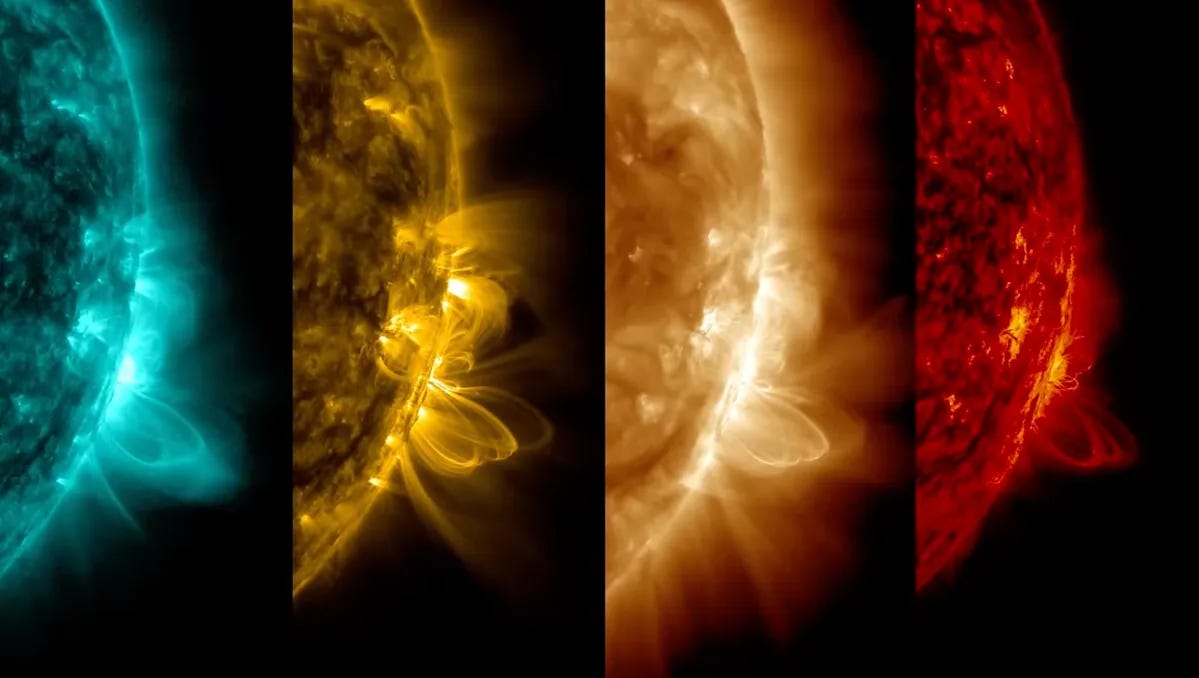
To provide some background for those of us who don’t regularly venture into the depths of niche subterranean space domains, space weather refers to the varying conditions within the Solar System (primarily dealing with the Sun, but other factors do contribute) that affect the members within the system.
A resource package provided by the University of Colorado Boulder offers a slightly expanded definition, which additionally considers:
Disturbances and variations in Earth’s space-atmosphere interface region that may propagate upward from Earth’s surface and lower atmosphere;
Influences of cosmic rays on humans, hardware, and Earth’s atmosphere; and
Similar disturbances at other planets that humans or their hardware may visit.
A variety of physical impacts are associated with space weather, including geomagnetic storms, solar wind, radiation belts, aurorae, coronal mass ejections, and solar particle events. For the sake of brevity and not wanting to go very far down this rabbit hole, I recommend researching these for yourself.
For a quick example, solar wind comes from the stream of particles consistently being emitted from the Sun’s hot outer atmosphere (the corona). The solar wind carries these particles, which are charged with electricity, toward the Earth at astonishing speeds. The Earth’s magnetic field, in conjunction with our atmosphere, protects us from the majority of solar wind blasts. When particles fail to be propelled, they hit our atmosphere, causing the glowing light shows known as auroras.
We’ve been aware of space-based weather affecting Earth-based occurrences dating back to the 1850s. Per Wikipedia:
In 1852, astronomer and British Major General Edward Sabine showed that the probability of the occurrence of geomagnetic storms on Earth was correlated with the number of sunspots, demonstrating a novel solar-terrestrial interaction. The solar storm of 1859 caused brilliant auroral displays and disrupted global telegraph operations. Richard Carrington correctly connected the storm with a solar flare that he had observed the day before near a large sunspot group, demonstrating that specific solar events could affect the Earth.
It was only when we began to launch satellites into orbit that researchers began to exhibit a more significant interest in space weather. Now, it’s still widely unclear the extent to which space weather events can cause physical impacts on our in-space or Earth-based infrastructure, but research suggests it impacts the following: spacecraft electronics, spacecraft orbits, humans in space, spacecraft signals, radio signals, electric fields, geographical exploration devices, and weather on the Earth’s surface.
What’s scary is that solar storms can happen suddenly, with their effects reaching the Earth in mere minutes. Scientists continue to try to create bigger and better models and technologies to assist with predicting when these will occur (building a space weather forecast similar to Earth-based weather).
A 2015 report by the National Science and Technology Council detailed the true extent of the issue space weather presents:
Space-weather events are naturally occurring phenomena that have the potential to disrupt electric power systems; satellite, aircraft, and spacecraft operations; telecommunications; position, navigation, and timing services; and other technologies and infrastructures that contribute to the Nation’s security and economic vitality. These critical infrastructures make up a diverse, complex, interdependent system of systems in which a failure of one could cascade to another. Given the importance of reliable electric power and space-based assets, it is essential that the United States has the ability to protect, mitigate, respond to, and recover from the potentially devastating effects of space weather.
The rest of the report outlines strategies to enhance response and recovery capabilities, improve protection and mitigation efforts, improve prediction capabilities, and increase international cooperation.
Credit Harvard Law School
Regulatory Lag Behind Innovation
Like many other industries and sectors, the space industry has technologically progressed much faster than its associated regulatory frameworks. As a 2025 article in Space is titled, “It’s very pro-commercial space right now.”
I talked extensively in Space Commercialization Part 3 about the history of space laws and regulations. I added the simple addendum that space advancements had massively outpaced laws and regulations, but didn’t dive into the depths of the issue.
As it currently stands, the framework of international space law contains significant gaps, as many of today’s endeavors are simply not covered by the historical international treaties. Previously, this didn’t matter as there weren’t any activities falling in those gray areas, but now that has dramatically changed.
For instance, one of these gaps is related to space waste, the Kessler effect, and other types of space debris in their entirety.
Due to these factors and others, international space law has become subject to various interpretations at each and every level. National governments have different interpretations from states, private companies, and international governing bodies. Rachael O’Grady writes concerning this issue:
This will result in the global fragmentation of space law at the domestic level, which is unlikely to be helpful in the long run and which will almost certainly make ultimate international consensus – arguably the only meaningful way forward – impossible.
Similarly, other issues have been presented, with some experts arguing that “The existing legal framework for space flight is inadequate to regulate the activities of the commercial actors in space.”
The Department of Defense attorney advocate John S. Geohring provides a framework that resonates with me:
The United States can create an ideal regulatory environment by balancing three main policy objectives: promoting growth in the commercial space industry; satisfying international obligations; and preserving national security.
Should we be hoping that regulation catches up?
I think this is definitely a double-edged sword. Take a similar industry, one composed of high-impact, highly technical, rapid development: nuclear energy. When regulation finally caught up with nuclear energy innovation, it overreacted and essentially overregulated the industry, leading to almost immediate stagnation.
So, in some cases, we should be hoping for more space laws and regulations to generally direct industry actors, but we should hope that these frameworks maintain a resemblance of relaxation, allowing for innovative wiggle room.
I think this viewpoint by Eytan Tepper provides a thoughtful perspective on the future of regulation (mainly the lack thereof):
Eytan Tepper of Indiana University at Bloomington argues that the “polycentric governance” of space, according to which no regulating force dominates, is both an inevitable and a preferable outcome. Tepper explains that space law initially developed under a “global governance” paradigm, characterized by centralized decision-making led by the U.N. and embodied by a series of treaties signed in the 1960s and 1970s. But he argues that today no new treaties are likely to follow because of international political gridlock. Tepper explains, however, that even in the absence of strong centralized governance, a flexible network of “governance centers” will ultimately emerge, allowing stakeholders to direct the international governance of space by contributing to the development of protective norms.
Credit SpaceNews
Supply Chain Vulnerabilities
A 2024 paper by Johns Hopkins University found that supply constraints in the space sector have struggled to keep up with increasing demands for military satellite manufacturing.
The private sector isn’t without its woes, too. Edwin Foster, writing in AInvest, explains the following:
SpaceX's supply chain challenges are equally daunting. The company's lean manufacturing model—designed to minimize inventory and maximize throughput—leaves it vulnerable to component shortages and supplier bottlenecks. Specialized materials, such as high-performance Raptor engines and avionics, require precise coordination with suppliers, many of whom operate under tight deadlines. The lack of in-house receiving infrastructure exacerbates risks, as shelf-life-limited materials are delivered directly to final assembly lines, leaving little room for error.
Now, historically, this model has served SpaceX very well - they’re the biggest private space company on Earth now. But it may end up being one of their main pitfalls.
This phrasing from Greenwood Aerospace states it perfectly: “As space exploration accelerates, the importance of secure and resilient supply chains becomes increasingly vital.”
In the space industry, the supply chain is incredibly complex and interdependent, with many different stakeholders from across the globe involved (e.g., government agencies, private companies, research institutions, individual contractors, billionaires, etc.).
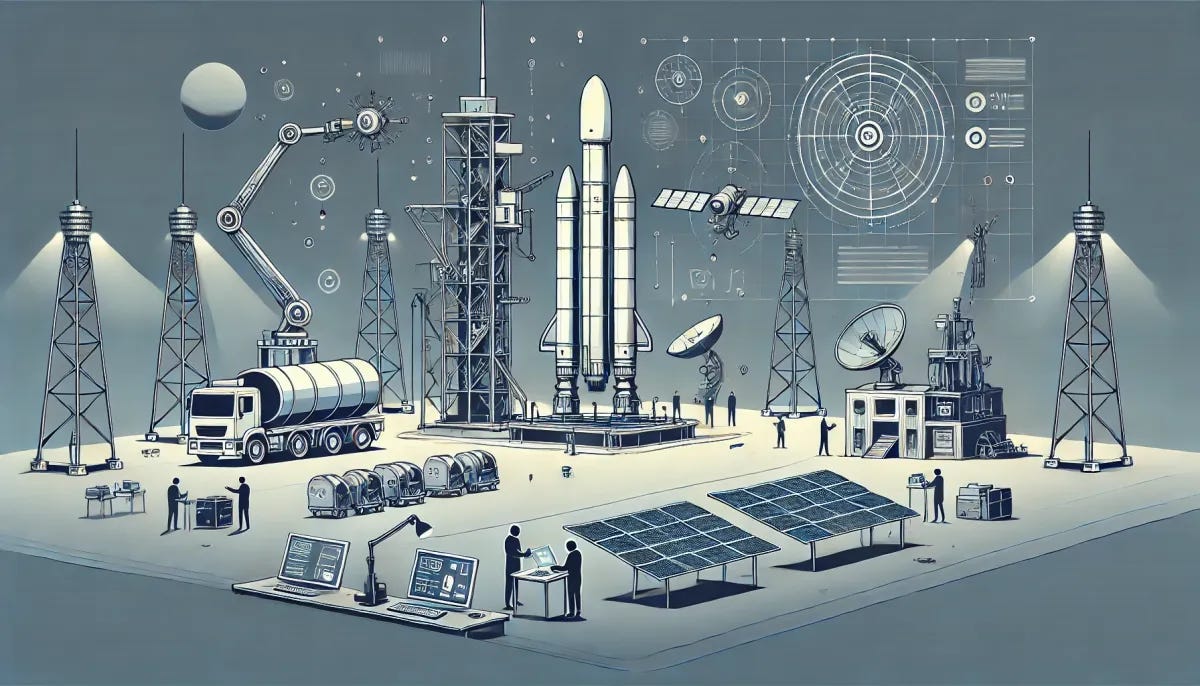
To give a quick overview of the space supply chain components, they could include, but are not limited to: electronic component providers, material and fuel manufacturers, subsystem manufacturers, payload manufacturers, satellite manufacturers, testing facilities and equipment providers, ground equipment manufacturers, ground station owners, logistics companies, software developers, launch service providers, consultants and service providers, regulators, satellite operators, space agencies, research institutions, and end users.
The space supply chain is an incredibly important portion of the space sector. The World Economic Forum and McKinsey have estimated that the global space economy is projected to expand to $1.8T in 2035 (up from $630B in 2023). Of that, the largest and fastest-growing segment is SCTM (Supply Chain, Transportation, and Mobility).
Many aspects of the space supply industry are unique compared to other industries. Firstly, space components and systems require extremely high levels of precision and reliability. As such, there are only a small number of providers on the planet capable of providing the components and systems required for these space vessels. This can create bottlenecks and vulnerabilities.
Secondly, the vast number of stakeholders across the globe from various facets of life (e.g., governments, businesses, individuals, nonprofits, etc.) creates complex legal and regulatory frameworks that must be navigated, adding an additional layer of complexity to the supply chain.
Thirdly, the space industry is reliant on cooperation from players across the globe, meaning that there are complicated cross-cultural, political, and economic issues at play in every step.
Lastly, the space industry is constantly undergoing innovation and development. This means that the supply chain must be flexible and adaptable to accommodate rapid changes while balancing long-term mission development and testing timelines and finite launch windows.
These unique aspects of the space industry create risks for its supply chain. A 2023 report by the Center for Space Policy and Strategy explains it as follows:
In the next 10 years, global space spending is expected to double. Higher global demand will drive increased pressure on the supply chain for the U.S. space enterprise. Companies are pivoting to high-rate production for critical national space capabilities, making supply chain efficiency more critical than ever. Other global market sectors (e.g., auto, medical device, gaming, and cloud storage industries) are competing with the U.S. space enterprise for many of the same components, commodities, and rare-earth elements.
To provide a couple of examples, the availability of space system components is affected by geopolitics, global economics, and competition from sectors outside the space sector. Specifically, the supply of noble gases used in space components has been disrupted by growing demand and geopolitical crises.
As such, systems are being put in place to analyze risks, project vulnerabilities, and further secure the global space supply chain. However, as it currently stands, the space supply chain continues to be vulnerable to all manner of potential threats.

Credit Adobe Stock
Spectrum Allocation Battles
Wireless communication across the globe and throughout our Solar System is possible through the use of radio waves. These waves are part of the electromagnetic spectrum (including microwaves, infrared radiation, visible light, ultraviolet light, x-rays, and gamma rays).
Each radio wave (and each wave in general) has a unique frequency (denoted in Hz), which determines how far the signal can travel. The radio spectrum is the portion of the electromagnetic spectrum that encompasses 30 Hz to 3,000 GHz.
The key part here is that the radio frequency spectrum is a finite resource. As such, the radio frequency spectrum is divided into a number of sections, with each band serving different applications. The National Telecommunications and Information Administration office provides the following breakdown for the current spectrum delineation:
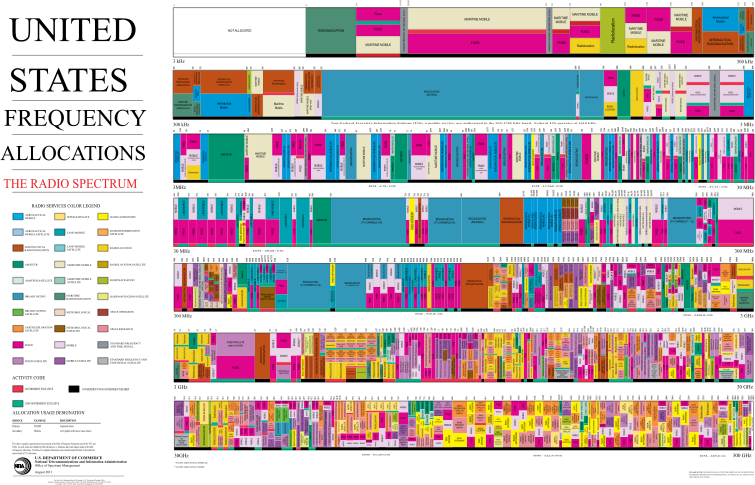
Credit Openclipart
Over the past decade, the number of wireless devices vying for space on the frequency band has exponentially increased. The problem we’re beginning to face is that signals close to each other cause interference with one another. As such, each radio signal needs some kind of buffer between them to avoid interfering with one another.
In the 21st century, we’re beginning to run out of space on the radio frequency spectrum. To clarify, given our current technological capabilities, we’re currently running out of space on the spectrum.
It’s possible to shrink the wavelengths we operate on (i.e., make them more concise, like going from 1Hz width to 0.5Hz width), but it requires better technology and hardware, so theoretically, we technically have an infinite number of frequencies to operate on.
Long story short, in order to unlock further radio frequencies, we need to make significant investments, causing radio frequency allocation to become increasingly expensive, elevating the barriers for space startups.
As of now, this “invisible real estate” is being claimed constantly, with little public scrutiny, often favoring well-resourced entities and potentially sidelining equitable global access.
Credit Space
Climate Impact of Launches
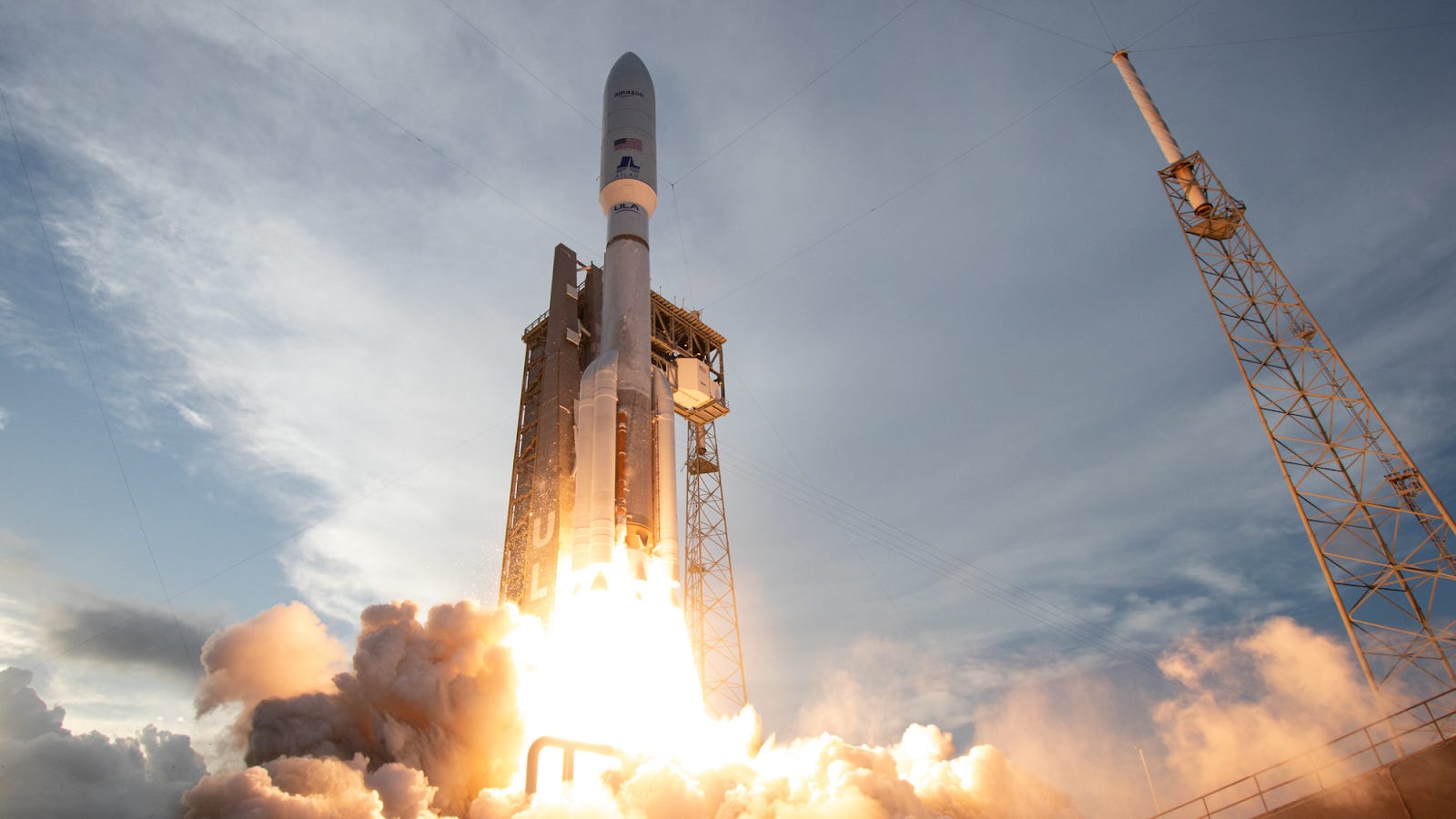
As of 2025, there have been over 10,000 objects launched into space throughout humanity’s history. Each one of these objects rode upon a rocket or other space-bound apparatus in order to get there. These rocket launches, specifically the propulsion systems, impact the environment significantly.
As the number of space launches is only expected to dramatically increase over time, it’s important to understand the climate impact of the space industry historically and in the future.
Many current rockets use a mixture of liquid oxygen and kerosene propellants. The oxygen doesn’t harm the Earth, but the burning kerosene creates soot that is injected directly into the stratosphere. A recent study by the National Oceanic and Atmospheric Administration (NOAA) found that rocket launches inject over 1,000 tons of soot into the upper atmosphere each year. The soot lingers for up to 5 years, absorbing heat, contributing to climate change, and damaging the ozone layer.
In aggregate, rocket launches are still minor contributors to the overall atmospheric pollutants. Global air travel currently burns 50 - 100 times more fuel yearly compared to all the rockets launched.
However, soot released by global air travel is in the troposphere, which quickly precipitates back down to the ground. In contrast, soot released into the stratosphere sticks around for much longer and therefore has a larger impact.
Additionally, rockets release a huge amount of water vapor into the atmosphere, which usually isn’t a problem, but in the stratosphere, where there is almost no water, these emissions can potentially have a warming effect.
The NOAA study found that a 10 times increase in the number of launches, which could happen in the next decade or two, would cause damage to the ozone layer and change atmospheric circulation patterns.
As of now, scientists don’t fully understand the long-term effects of pollution so high up in the atmosphere, but it’s quite clear that there won’t be positive effects, only negative ones.

Credit Unblast
The Silent Saboteurs of Our Space Dreams
The future of space is undoubtedly bright, but that’s not necessarily a given. The threats and challenges we’ve explored—from the environmental impact of space launches to the issues allotting radio frequencies to critical supply chain vulnerabilities—are real and demand our attention.
These issues, while not as exciting as discussing next-gen software, satellites, or launch capabilities, are just as important to our future abilities in space. Furthermore, these aren’t just issues that can easily be addressed by one or two members of the space establishment. Instead, they require worldwide input and collaboration from stakeholders at every level.
Addressing them requires a coordinated approach: investing in sustainable launch technologies, fostering international cooperation on spectrum allocation, diversifying and strengthening supply chains, developing agile regulatory frameworks, and enhancing our abilities to predict and respond to space weather events.
In his book, The Last Lecture, Randy Pausch discusses how his life was impacted by space:
Men first walked on the moon during the summer of 1969, when I was eight years old. I knew then that pretty much anything was possible. It was as if all of us, all over the world, had been given permission to dream big dreams.
Our ambition to reach for the stars is a testament to human ingenuity. By proactively confronting these often-overlooked challenges, we can ensure that our journey to the depths of the universe is not only inspiring but also sustainable and secure for generations to come. The next giant leap for humankind depends on how well we navigate these earthly and near-Earth complexities today.
That’s all for today. I’ll be back in your inbox on Saturday with The Saturday Morning Newsletter.
Thanks for reading,
Drew Jackson
Stay Connected
Website: brainwaves.me
Twitter: @brainwavesdotme
Email: brainwaves.me@gmail.com
Thank you for reading the Brainwaves newsletter. Please ask your friends, colleagues, and family members to sign up.
Brainwaves is a passion project educating everyone on critical topics that influence our future, key insights into the world today, and a glimpse into the past from a forward-looking lens.
To view previous editions of Brainwaves, go here.
Want to sponsor a post or advertise with us? Reach out to us via email.
Disclaimer: The views expressed here are my personal opinions and do not represent any current or former employers. This content is for informational and educational purposes only, not financial advice. Investments carry risks—please conduct thorough research and consult financial professionals before making investment decisions. Any sponsorships or endorsements are clearly disclosed and do not influence editorial content.