


Today’s newsletter includes an interview Q&A brought to you by… MyAtlas Health

MyAtlas is a Boston-based provider of personalized, modern mental health resources, partnering closely with healthcare providers while also serving consumers directly, enabling all to easily access high-quality mental health care. They specialize in a data-driven approach, utilizing existing products and patient regimes to maximize engagement and everyday insights.
The interview Q&A provides a founder’s perspective on critical business, strategy, and career decisions, drawing on her experience as a practitioner and, now, as a business owner. Key points discussed today include:
Key areas of value creation relative to the competitive landscape
Identifying and prioritizing the problems you were meant to solve
Optimizing your solution for customers’ needs
In-depth analysis of the mental health industry, with a focus on distribution channels and demographic differences
👋 Hello friends,
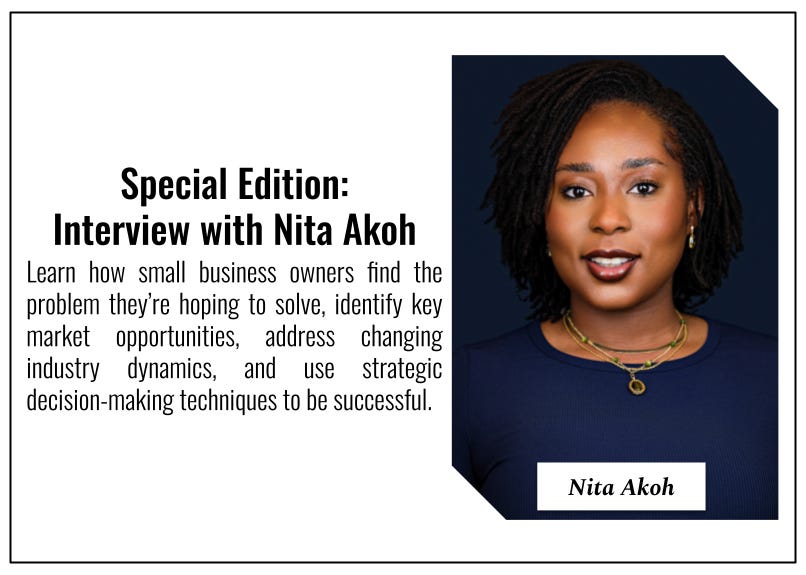
Thank you for joining this week’s edition of Brainwaves. I’m Drew Jackson, and today I’m bringing you insights from a lovely conversation I had with Nita Akoh, founder of MyAtlas Health.
Quick Context: New to Brainwaves? We explore the forces reshaping our world across venture capital, energy, space, economics, intellectual property, and philosophy. Subscribe here for bi-weekly deep dives plus weekly current events.
Time to Read: 16 minutes.
Let’s dive in.
🛑 Important Content Warning 🛑
Before you continue reading:
Please be advised that in the following interview, Nita discusses the difficult and sensitive topic of losing people close to her by suicide.
We recognize this is a painful subject. If this content may be upsetting or triggering for you, we encourage you to prioritize your mental health and skip this article.
Immediate Support: If you or someone you know is in crisis, please reach out for help. In the US, call or text 988 to connect with the 988 Suicide & Crisis Lifeline. For international resources, please visit the International Association for Suicide Prevention (IASP).
Q: Background on Nita and Her Company
Nita was born and raised in Port Harcourt, the capital of Rivers State, Nigeria. As a kid, Nita quickly discovered she was obsessed with brain behavior, loving watching shows like The Mentalist. As Molly Callahan writes about Nita in Women Who Empower, “Growing up, there just wasn’t much talk about mental health in her family, or in her larger community. But Akoh has always been a curious, observant person, and says that, despite the cultural taboo, she could tell that one of her aunts struggled with mental health issues. Akoh just wished someone would talk about it.”
Around age 13, organizations in Nigeria were scouting for gifted kids based on SAT scores. Nita took the test and received her best score ever, which led to her being offered a scholarship to attend a private school in Canada.
This scenario was scary for her parents, as Nita would be living alone in a new country, but they saw it as an opportunity for her to grow in her love of neuroscience, so they allowed her to go.
At 14, Nita moved to St. Catharines, Ontario, a tiny town near Niagara Falls, and enrolled in a boarding school there. Given that she was an outsider, she had to face a whole new reality of who she was and what she meant to some people. It was very lonely being away from home, having to navigate a new system and deal with unique, unknown challenges.
Luckily, Nita found a really good friend (who we’ll call Sarah) who became her home away from home at that time. A year later, after they had developed a fantastic bond, Nita walked into her room and found her dead. She had committed suicide. That was a massive reality for her to face.
As Nita states:
And that was a huge reality for me to face. First of all, being the one to actually see her at that stage and to know what mortality is at a young age. And I think a lot of people who have been through that same kind of pain, losing a loved one due to suicide, the guilt you feel is the same. You know, it’s kind of like, I wish I would have done something, like, why didn’t I know sooner?... You know someone is sad, but you don’t really know how sad they are. You don’t really know how bad it is because it’s not a boil you can see that’s red, or it’s not like a flu, where you can see the person coughing and know they really need attention.
She carried that guilt with her for a long time. This guilt was what truly pushed her to focus on neuroscience. Fast forward to 2018, and Nita is accepted into Northeastern University. She decides to double major in behavioral neuroscience and international affairs.
She really wanted to help people, so her goal was to become a doctor, believing that was the best way to make an impact. Life had a different path planned for her. She started working on various projects, including one at the Epic Brain Lab. It’s a collaboration among Northeastern, Harvard, and MIT, full of students and researchers working to develop innovative ways to help people with disorders.
Her focus was on people with schizophrenia. You may not be aware, but they have the highest mortality rate out of everyone who has mental health disorders. Her role was to create games that would reduce auditory hallucinations for her patients.
This act of creating something that would help these people come into the lab three months later, actually in a better state, really made her understand that she preferred designing preventive care to helping with the aftermath.
In another of her clinical experiences, she worked at a large psych hospital in the Boston region as one of the members in charge of post-discharge care. She was to ensure that when people left the center, they didn’t come back. Unfortunately, a large portion of the industry has close to a 60% relapse rate, so it was pretty certain when patients were leaving that they would be back.
In one of these cases, a patient left, and then weeks later, they died. As Nita recalls, “And it was that same guilt that came back to me again, sending people home and then hearing that they actually died like a week after. I felt that same guilt, and looking into the large mental health ecosystem, I actually found that this was not just a solo feeling; it was actually a systematic problem, where 60% of the people who commit suicide actually saw a clinician just weeks before.”
As Molly Callahan writes, “As soon as she resumed her academic courses, she signed up for coding and entrepreneurship classes, determined to find a more elegant and efficient solution to such a thorny problem as mental well-being. Akoh buried herself in her studies, forfeiting nights out with friends and other fun events to push forward with her work.”
This experience directly led her to start MyAtlas Health, a platform focused on prevention, specifically centered around making the pain of mental health visible. They gather data to provide clinicians and patients with a clearer view of their health and its trends over time, enabling proactive prevention and early intervention.
Credit MyAtlas
As Molly Callahan writes:
Akoh was eager to develop her business, but knew she’d need help. She leaned on her Northeastern community to help her learn how to navigate a complex business ecosystem in the U.S.
“I started with the basics,” Akoh says now, laughing. “I mean, like, ‘How do taxes work?’” She reached out to student leaders and faculty mentors to start building out her idea.
Between her clinical experiences and founding MyAtlas, Nita spent time in consulting at IQVIA and Global Research and Consulting Group, learning more about the healthcare innovation ecosystem to gain the best possible understanding before founding a company in the space.
MyAtlas uses data from everyday devices to understand and predict mental health decline and risk. The goal is to get people the proper care with the right resources and right clinicians before they resort to going to an ER or, in the worst-case scenario, actually committing suicide.
As her Halcyon profile states:
Under her leadership, MyAtlas has been recognized for its innovative approach, earning accolades such as the Mass Innovation Network Eddies Award and the Women Who Empower Innovator Award from Northeastern University. Nita has been honored as a Young Innovator in Behavioral Health by Hopelab. Her work focuses on integrating culturally informed data analysis to bridge care gaps for minority communities, aiming to make mental health care more accessible and personalized.
Q: As mental health continues to be at the forefront of conversations, more and more resources are being developed to help address gaps in the market. How do you see the industry trending over time?
Nita explained that she sees two problems with mental health: access and visibility.
Many companies on the market are trying to solve the first problem, making it easier for people to see clinicians.
However, from Nita’s perspective, she doesn’t see the current mental health crisis as only a care gap. Yes, there isn’t enough care, and demand continues to grow each day. However, one of the main culprits is that we aren’t catching these cases early enough.
A vast majority of mental health issues can be detected years in advance—for instance, it usually takes about 10 years for someone to get diagnosed with schizophrenia. Think of your life: there often are early warning signs, whether that be not being able to sleep as easily, having high stress, and then a couple of months down the line, you finally need to see a clinician.
The goal of MyAtlas is to address this latter aspect, the visibility gap or measurement gap, where there’s no good way to know what stage someone is at in their journey. Right now, clinicians across the country continue to rely on qualitative data reported by patients when they see them. As Nita cites, “Imagine asking somebody who’s addicted to drugs, how they’re doing and being able to trust that what they’re saying is exactly scientifically what you can use to actually make a care pathway for.”
Throwing care at the mental health crisis isn’t the only and best solution, especially when you factor in the fact that many of the people who are predisposed to these conditions don’t have good health insurance or reasonable premiums.
Right now, the market is slowly leaning towards a more preventative approach. Legislators have started to include behavioral health integration in many care systems. This area of need is becoming a topic of conversation. Insurance carriers are beginning to reimburse for solutions that provide for these needs.
In these ways, MyAtlas is a bit early to the market by using data as a metric for mental health in this ecosystem of preventative care, but they’re very excited to be at the forefront of change.
Q: Given the presence of resources currently on the market, how does your company differentiate itself from competitors?
Nita acknowledges that they do have some significant competitors. For instance, one of them is NeuroFlow, an EMR system that houses a large portion of clinical data. They perform risk analysis and risk stratification, but this is based solely on data collected through patient surveys and in-person clinician visits.
MyAtlas takes a different approach to the market, partly because its initial focus was on the young adult population, who are less likely to engage with the healthcare system. They’re more at risk of mental health disorders, and they don’t engage with the healthcare system through traditional survey methods.
As Nita previewed, the current healthcare system still relies on the premise that patients can tell you how they’re feeling so you can adequately address their concerns.
MyAtlas sought alternative methods of data aggregation to build a background EMR system. For instance, they collect data from a person’s phones and devices on sleep, heart rate, location, pulse, temperature, and other interesting metrics, such as battery percentage behavior. They can look at all those sources and tell the story of a person’s behavior and how it affects their care.
Another huge gap in the market, Nita cites, is that most of their competitors are focused on the big healthcare systems (which have the largest budgets). However, most of the high-risk population aren’t going to those centers; they’re going to mid-sized clinics and community healthcare centers.
There hasn’t been strong penetration in these centers because their competitors charge much higher prices for their enterprise-based solutions, which are more tech-enabled, human-evaluation services with a significant human component, helping work through survey results to suggest care.
In contrast, MyAtlas is building AI models to identify the best care pathways and enable early detection for every patient type. For example, the care path for someone who just graduated from college and is beginning their career is going to be very different from someone who moved halfway across the world for school to a new place without a strong support system. As Nita explains:
Currently, our competitors have people making this decision, but we’ve been able to get a lot of data sets from organizations like Northeastern, University of Minnesota, and recently the Mayo Clinic to actually allow us to train our models so our artificial intelligence is doing every single thing a person would typically do. And because of that, we’re actually able to charge a very low price of $400 per patient per year. This is significantly cheaper than a lot of our competitors, but this also allows us to go to those mid-market healthcare centers and actually provide innovation to them and the populations they serve.
The last reason MyAltas differs is its patient engagement. Many of the digital health solutions on the market are highly clinical; however, they’ve realized that a solution is only as good as people’s willingness to use it, so they’ve been experimenting with ways to incentivize people to use the app and complete care.
One method is to give people credit and rewards for interacting with the app. For instance, the app may say something along the lines of “Hey, we noticed you haven’t been sleeping well. How about you go to bed at 9 today?” And if the person goes to bed at 9, they get a reward that they can spend at local businesses. This way, they’re incentivized to address their health, and the rewards push them out into their community.
This has resulted in an engagement rate of around 45% on their app, compared to the industry standard of ~18%.
Q: Who is your ideal customer
Initially, they began serving end users directly through their app launch in May 2025, as part of Mental Health Awareness Month. They gave the app to 100 college students who needed mental health care but couldn’t afford it.
They found that after monetizing the app at $10/month, they didn’t really need to market it, as people were referring it to others and it grew organically through word of mouth. An interesting thing they saw was people screenshotting their data or reaching out to ask for it to share it with their clinician, so their provider would actually know how they are doing.
This was the entryway they used to gain access to many clinics, which provided them with a continually larger patient base.
Now, they still have the direct-to-consumer app, and they’re working directly with clinics to deliver their solution to patients via a clinician portal, where they send all patient insights.
Q: What are your company’s plans for future growth?
In the long run, Nita doesn’t see MyAltas just as a product to offer to clinics, but as the behavioral intelligence layer of the healthcare system, integrated into all aspects of the health ecosystem. For instance, there are medications prescribed in other regions of the healthcare system that increase suicidal ideation, so pairing their solution with those interventions will provide a better, longer-lasting outcome with a lower risk of adverse outcomes.
In the short run, this manifests in many different ways.
For instance, one of the strategies they are currently pursuing is visiting recovery centers to pitch their product as an innovative continuum-of-care solution.
Another aspect of growth is approaching insurance companies to keep people healthier and reduce the overall cost of care by reducing readmissions and ER visits, which are expensive for insurance companies.
They’re also fundraising, trying to build a more exciting user interface, embed AI into the app experience, and use algorithms to further tailor the in-app experience to individual users.
Lastly, they recently entered into an R&D partnership with the Mayo Clinic for 20 years of access to its data to build models that can continue to help patients in the clinic and across the country.
Q: What piece of advice would you offer to anyone looking into starting their own business?
Nita recommends four things:
1) Make sure you understand that you have an idea and not a business.
2) Don’t focus on selling, focus on discovery. If she could do it again, before writing any line of code or drawing up any plan on paper, she would interview 100 people whom she thinks would buy the solution to see what they truly need. The more you know, the better.
3) Value critique highly. She wishes she could stand in the financial district with her company’s financials displayed on a billboard for every passerby to critique. You’re only as good as your harshest critic, so if you can find this person, then you can take your offering to new heights.
4) It’s not magic, it’s just hard work. You need to put your ears to the ground and know that you’re creating something that needs attention and a good person to steward it along its journey. Once you understand that relationship, then you’ll be well prepared for anything that comes your way.
My Takeaways
First of all, it was fantastic to learn from Nita and hear more about her story. It was interesting to hear about her career trajectory and her strategies for building and growing her enterprise.
I want to thank Nita again for the fantastic opportunity to benefit from her insights!
A Quick Aside on My Rationale With This Approach:
My goal in reaching out to Nita and people like her is to highlight that all businesses face strategic challenges at each step of the growth journey. In school, you traditionally only learn about the “best of the best”, those Fortune 500 companies that have hundreds of case studies written about them.
Yet, there’s value in the unique insights from small business owners who are on the ground, constantly navigating critical decisions every minute.
How much do I price my product? Who should I hire? How should I expand my business? What do I do if my sales are down? — All the questions that small business owners face constantly.
Now, on to the critical lessons I want to highlight from my exchange with Nita.
Lesson #1: Finding the problem you’re meant to solve takes time
For some people, it takes a lifetime to figure out what problem they’re meant to solve. For others, they find it earlier on and can create lasting change over the course of their lifetime. I think of this quandary as similar to finding your life’s purpose—some find it quickly, while others take a long time.
Nita knew she wanted to do something in neuroscience and healthcare from a young age. Through a variety of educational opportunities and internships, Nita slowly refined exactly what she wanted to do in life: proactive mental health support.
However, when you read deeper into her story, it wasn’t sunshine and rainbows. It required a move across the world, tragedy, long hours working tirelessly at institutions she didn’t always love, and many more milestones.
Throughout, 3 key lessons emerge:
You need to find the right people to help mentor you
You need to be exposed to a wide variety of opportunities
Sometimes you need to go down to go back up
Lesson #2: Optimize your solution to best fit your customer’s needs and existing workflows
I’ve read a lot of articles on the science (art) of product-market fit recently and wanted to specifically call out Nita’s approach as one of the best I’ve seen.
As this LeanFoundry article explains, in the early stages, finding your fit is a mix of the founder, the customer, and the market. Each portion needs to succeed for the startup to achieve proper product-market fit at the right time and place. I believe Nita did some things exceptionally well to achieve her product-market fit.
Firstly, Nita developed a solution that utilized many of the users’ existing workflows and equipment. For instance, as discussed previously, the technology integrates with phones and wearable devices to analyze existing data and derive insights. This solution doesn’t require users to make radically different lifestyle changes to receive benefits; they can gain insights from their current routines. This has led to higher adoption and utilization rates.
Secondly, Nita understood how to tailor her approach to the younger generation—a process that larger healthcare competitors continue to get wrong to this day. MyAltas launched through free software giveaways on college campuses, driving word-of-mouth referrals and localized hype centers. Furthermore, the product’s built-in ability to earn rewards that can be spent throughout the local community incentivizes use and resonates further with the young population.
By causing minimal disruption to existing processes and incentivizing use (through free opportunities and rewards), MyAltas has optimized its solution to best fit its specific end customer demographic.
Lesson #3: Growth through word-of-mouth signals strong product-market-fit
Building nicely on the previous point, Nita’s technology has primarily grown through word-of-mouth referrals, a powerful yet incredibly complex marketing channel.
A referral requires a person to put some of their social credibility on the line to vouch for a certain product or service. Everyone is different, but for this to occur, the product or service usually needs to meet a threshold wherein the person feels comfortable taking that gamble.
As previously explained, Nita’s product is leaps and bounds beyond many of those thresholds, leading friend groups and networks to constantly circulate referrals to the solution.
This is one of the strongest signals of product-market fit: your end users like the product so much that they want all their network to have it. Yes, each business will have these in isolated instances, but driving a significant portion (here, a majority) of growth through this channel truly speaks volumes and is highly commendable.
_______
I want to say another thanks to Nita; it was great learning all of these things from her experience, and it is even better that I can share them with you.
I hope you read something valuable in the above discussion and takeaways that will influence how you approach business or even your life in general.
That’s a wrap on this deep dive.
Found this analysis valuable? The best way to support Brainwaves is to share it with someone who’d benefit from these insights.
Drew Jackson
Founder & Writer
Share This Analysis
Keep Exploring
Next Deep Dive: Revisiting Value Creation & Capture - February 4th, 2026
This Saturday: Weekly roundup of breaking developments across energy, space, venture capital, economics, intellectual property, and philosophy
Previous Editions: View the archive here
Stay Connected
New to Brainwaves? Join thousands of readers getting bi-weekly deep dives into the forces reshaping our world.
Sponsor This Newsletter: Reach an engaged audience of forward-thinking readers. Email us for details.
Disclaimer: Views expressed are personal opinions, not financial advice. This content is educational only. Investment decisions carry risks - always consult professionals and do your own research. All sponsorships are clearly disclosed.
© 2026 Brainwaves. All rights reserved.