


Today’s newsletter includes an interview Q&A brought to you by… Microcosm Publishing

Credit Microcosm Publishing
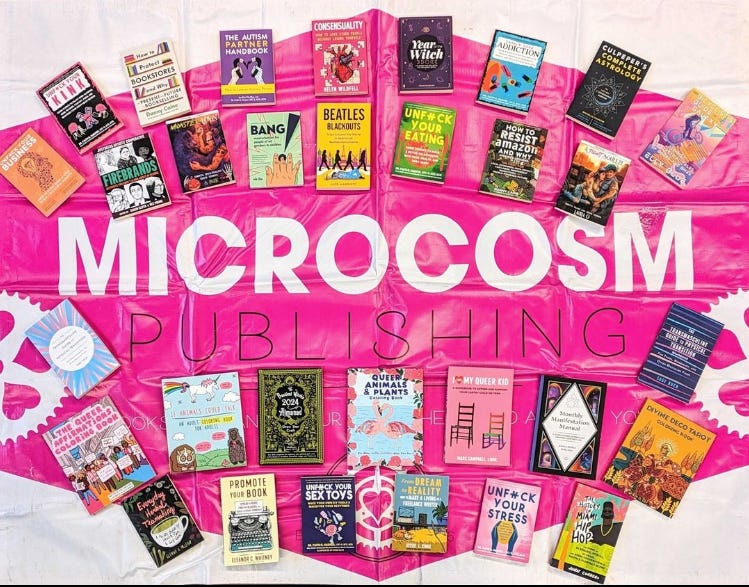
Microcosm Publishing is a Portland-based provider of curated books, zines, decks, and more through their publishing, distribution, and wholesale programs. Their products emphasize skill-building, critical thinking, community, and creativity. They carefully pick each product, aiming to relate to the experience of marginalized people, remove barriers to success, and foster underground movements.
The interview Q&A provides a founder’s perspective on critical business, strategy, and career decisions, drawing on his experience as a practitioner and, now, as a business owner. Key points discussed today include:
Key areas of value creation relative to the competitive landscape
Finding a business through the pursuit of a passion
Optimizing the size of the customer base relative to competitors
In-depth analysis of the publishing industry, with a focus on distribution channels and demographic differences'
👋 Hello friends,
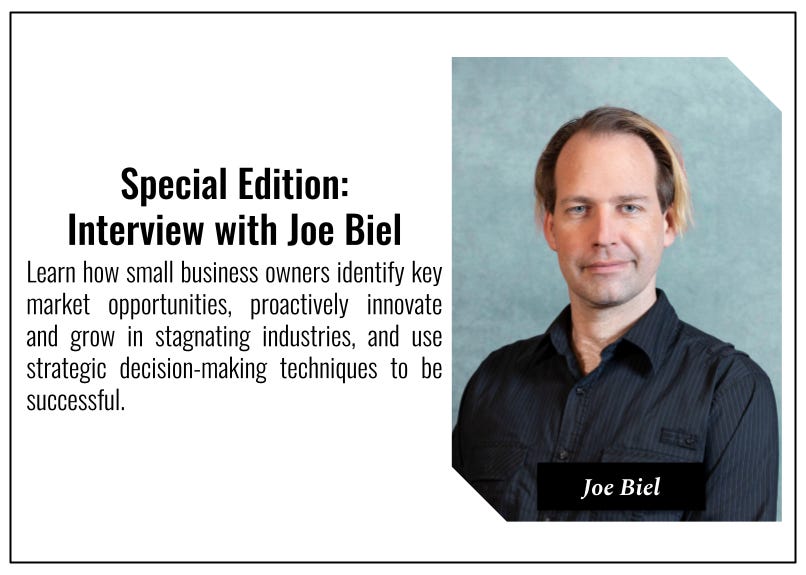
Thank you for joining this week’s edition of Brainwaves. I’m Drew Jackson, and today I’m bringing you insights from a lovely conversation I had with Joe Biel, founder of Microcosm Publishing.
Quick Context: New to Brainwaves? We explore the forces reshaping our world across venture capital, energy, space, economics, intellectual property, and philosophy. Subscribe here for bi-weekly deep dives plus weekly current events.
Time to Read: 12 minutes.
Let’s dive in.
I recently had the pleasure of connecting with Joe to dive into his insights and experiences. It’s a great look at his perspective, and I’m excited to share his take on these topics with you.
Q: Background on Joe and His Company
In the mid-90s, I was an at-risk, undiagnosed autistic kid who discovered punk rock and zines at clubhouses run by people a few years older than me. Microcosm started as a reason for me to get out of bed every day in the 90s. I wanted to create resources that were lacking for me as a teen, presented in a way that would be attractive to someone like me. It wasn’t intended to be a business; I wanted to create the tools for people to change their lives and the world around them. In my case, those happened to be books.
Courtesy Microcosm
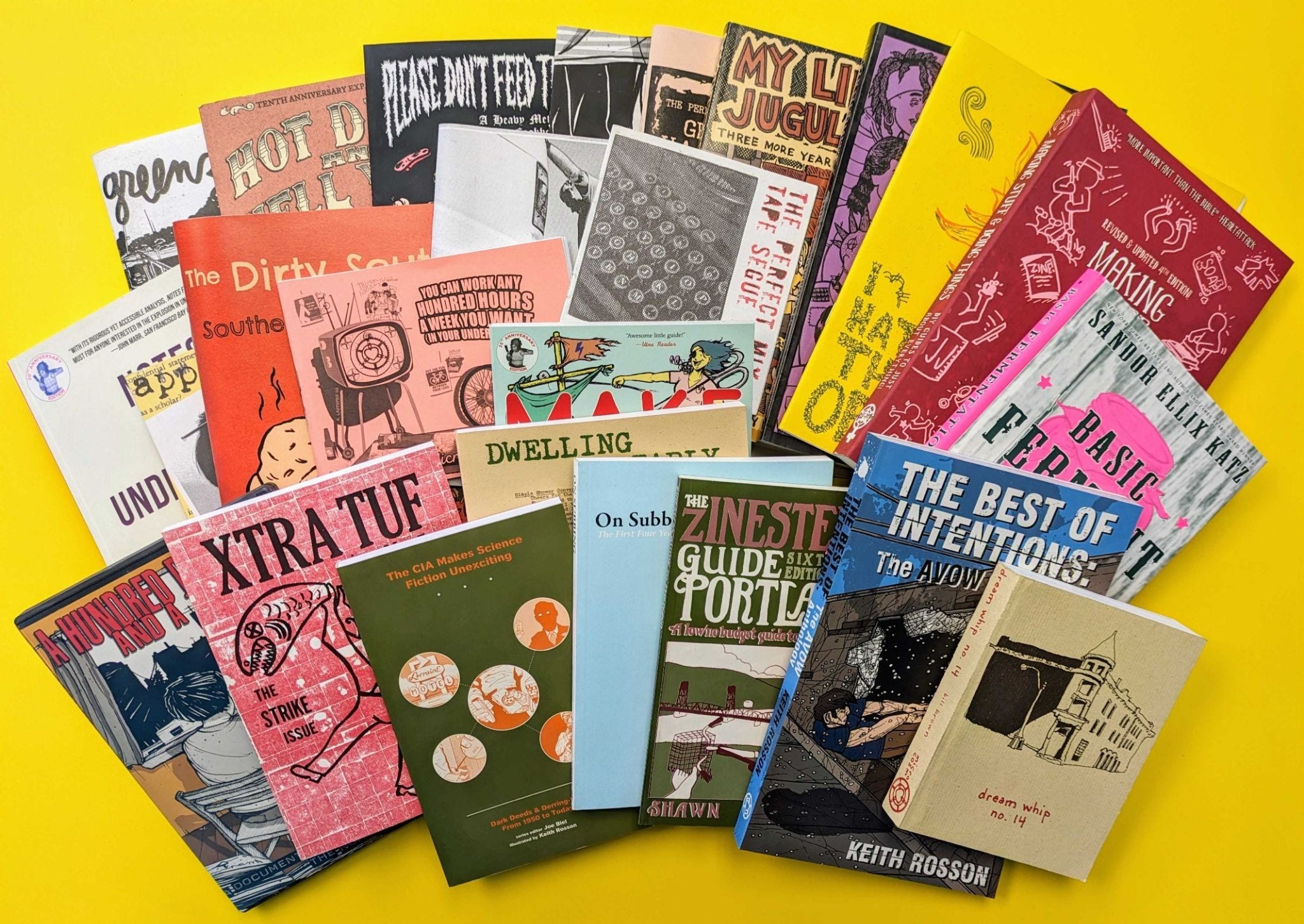
I started publishing stuff by my more creative friends. I knew someone who worked at a Kinko’s and someone who could ship things for me for free through their work. So I would set up behind the bar at local punk shows in Cleveland. Around 1996, I had been doing this for a few years, and so I decided to give it a name, to be more official. Or maybe it was the general confusion that people would write for a catalog but not know who they were writing to, so a single name to tie it all together made sense.
Incredibly, this had the effect of resonating with millions of people and was attractive to many wide subsets of the population that hadn’t felt acknowledged previously by publishing. We were the fastest growing company in our entire industry in 2022, according to Publishers Weekly and the third fastest for the next two years, when I was honored with the first Innovator Award, the only award for people in my industry between 30 and 65. While Microcosm was never meant to be a “job,” it could consume hundreds of hours per week just from keeping up with the letters and the orders and keeping things in print. We were doubling each year for three years, and 1086% growth in eight years! It was meant to be a reason to stay alive, and that’s why it was so successful—because it went on to do that for people other than myself. I think that echoes with people much more than I ever realized. This hasn’t changed at all in 30 years—we are just getting 5% better at it every year.
Credit Amazon
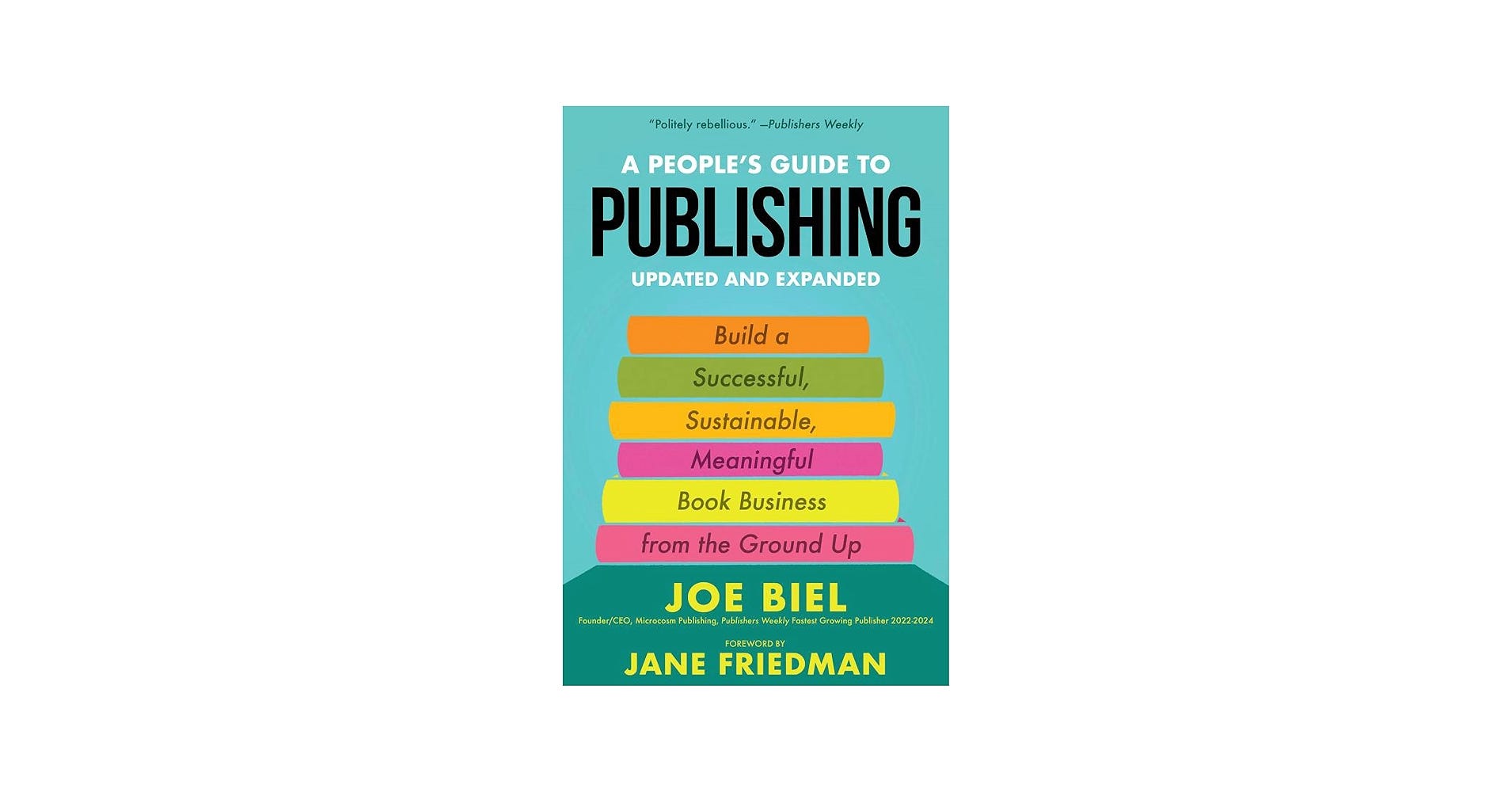
We sold our 25 millionth book for our 30th anniversary. To share what I’ve learned, I published A People’s Guide to Publishing in 2018 with a new edition in 2026 and the accompanying podcast of the same name, where we answer a question about publishing each week.
Q: What does the publishing industry look like, without including your company?
It’s still the 1800s over here. People would rather go out of business than change. You could draw a map to a treasure chest and everyone would respond that they are too busy with their P&P to go get it. This makes it really easy to innovate and grow. Book publishing is remarkably robust. Sales grow with the population and experienced a nice bump during the pandemic.
Courtesy Microcosm
That said, the market is very crowded and competitive. Even from the ten largest companies in the industry, 51% of books sell fewer than 1,000 copies per year. To compensate, publishers further flooded the market with crap that exasperated the problem. Consolidation and buying successful properties are seemingly the only strategies that corporate publishers understand for growth. During the Penguin Random House / Simon & Schuster merger trial, it was revealed that the only way that these companies know how to grow is through distributing independent presses—whom they can presumably data mine. New publishers are frequently shocked at how difficult it is to break in and make a splash—even when you have great books.
The combination of an industry where it’s getting more difficult to win organically yet is exploitable can be dangerous. Fifteen years ago, a packaging company signed the rights to use a teenage girl’s name, sold the film rights, rewrote her book for screen adaptation—while introducing 40 instances of plagiarism—and then hired a crisis response team for her to downplay the packager’s involvement and put her on Kate Couric to face the music.
A third of all books are sold online, but the majority are still sold in brick-and-mortar shops, given the consumer’s preference for analog. And it’s not just bookstores. Most gift and specialty stores sell books—even more than bookstores, according to the annual figures.
Q: Following up on the previous question, what value and/or differentiated model is Microcosm Publishing bringing to the publishing industry? What does the market look like for your solution?
Our competitors focus on the top 20 largest accounts. Some of these you would have heard of. They outsource sales to third-party companies that have consolidated and become less effective. The problem is that the shelf is incredibly crowded, and you get boxed out quickly. So we focused on the 15,000 smallest accounts. We essentially built a parallel economy, and about 5,000 of these accounts buy all of their books from us. We stress value proposition in our development so that every book finds its audience. We focus on audiences that are neglected by the industry. Many of these things are obvious to me, but it’s mostly because I wasn’t educated in a traditional publishing environment and nobody put any expectations on me. So I was free to go where things made sense.
We built our own WorkingLit software first as early ecommerce and then later as a series of relational databases that manage all aspects of our operations. From accounting to inventory management to order fulfillment to metadata distribution to marketing analysis. We can essentially automate our entire organizational structure. We made this software available for other publishers to use and it’s fascinating learning about their businesses and migrating them from clipboards and spreadsheets. This was a matter of giving back from our success.
Q: What are your plans for future growth?
The best KPI that we have is how many letters we receive each week that someone wouldn’t be alive without one of our books. As long as we are receiving communications like this, we know that we are relevant and then it’s just a matter of convincing retailers of this.
We built out segmentation charts for our 14 key specialty markets and have developed marketing plans for each of them. It became clear last year that sales are incurred by successive customer touch points; meaning that the more that we contact our customers, the more that they order. So by knowing our customers and their interests and proclivities, it’s fairly easy to use the tools that we built to continue to grow outwards into adjacent book categories and retailer types.
After years of turning down requests for me to do consulting, I found a way to make that work sustainable too. It had been very frustrating to be requested to do consulting, figure out someone’s problem in a few minutes and solve it within an hour...then have them decide that they don’t want to change after all and defeat the entire purpose of hiring me. Nowadays, I make them agree upfront that they are both able and willing to change before we commit to any consulting together. This was transformative as previously people would seemingly hire me to have someone to kvetch at, rather than someone to fix their organization with.
Q: If you had to give one piece of advice for aspiring entrepreneurs, founders, and business owners, what would it be?
Reject the traditional methods that aren’t working for you. Find the shortest path from where you are to where you want to go. The underground is much bigger than the mainstream. And the relationships are much more real.
My Takeaways
First of all, it was fantastic to learn from Joe and hear more about his story. It was interesting to hear about his career trajectory and his strategies for building and growing his enterprise.
I want to thank Joe again for the fantastic opportunity to benefit from his insights!
A Quick Aside on My Rationale With This Approach:
My goal in reaching out to Joe and people like him is to highlight that all businesses face strategic challenges at each step of the growth journey. In school, you traditionally only learn about the “best of the best”, those Fortune 500 companies that have hundreds of case studies written about them.
Yet there’s value in the unique insights of small business owners on the ground, constantly making critical decisions.
How much do I price my product? Who should I hire? How should I expand my business? What do I do if my sales are down? — All the questions that small business owners face constantly.
Now, on to the critical lessons I want to highlight from my exchange with Joe.
Lesson #1: Start with passion, then build a business later
Some of the very best business people I’ve ever met started their ventures as passion projects, simply to fill time, use their skills, help others, and give back to their communities.
Joe is no different, describing how he grew up without access to resources that would have helped him navigate the world effectively. Luckily, he found a home in Cleveland’s underground punk rock scene. He quickly became a zinester, creating self-published independent zines and comic books.
During this time, Joe found the perspective and motivation to fully pursue his own thing, and he began the project he continues to this day. It wasn’t originally founded as a mainstream business venture as it is today; it was born purely out of survival, desperation, and passion.
Many of us, in our own ways, are like Joe—we have passions, interests, and other initiatives we’re working on, thinking about pursuing, or hoping to one day have the opportunity to run after. For many, all it takes is to dive in, like Joe experienced, jumping into the opportunity with both feet and doing your best to survive.
Startups founded this way are more likely to survive and expand, and they exhibit greater scrappiness to ensure survival and expansion in any scenario.
Lesson #2: Building strategies for innovation and growth in a stagnant industry
Many industries are aging, with legacy incumbents set in their ways, creating a general air of stagnation. These environments are ripe for disruption by scrappy, innovative newcomers like Microcosm.
Joe outlined a few strategies they’ve employed in his words above, including catering to and resonating with millions of underserved individuals, focusing on smaller customers with deeply ingrained relationships built on trust and respect, and a tech-enabled backend to enable efficient business and product management. In addition to these, I want to highlight other strategies they’ve used to grow and innovate.
Firstly, they’ve launched a major initiative to sell books to stores that don’t traditionally sell them, targeting these alternative retail spaces as key market segments. This practice places zines and books in proximity to their target subcultures. These places include bike shops, taco stands, record stores, clothing boutiques, and feminist and community spaces.
Second, they’ve vertically integrated to cut out the middleman. Standard publishing relies heavily on corporate distributors to get books into stores. Conversely, Microcosm has built its own distribution wing, managing its fulfillment centers, retaining more profit per unit sold, and gaining greater flexibility.
Finally, they practice a methodology of radical financial transparency through a careful break-even model. Technically, Microcosm is a for-profit entity, but they intentionally operate on a break-even philosophy. Instead of accumulating excess capital, all profits are reinvested in staff wages, a worker-ownership program, and funding upcoming book releases. This means they don’t have to stress over saving a bad quarter, as every dollar is put to work instantly, creating a resilient, self-sustaining loop.
Ultimately, I think Joe’s advice is perfect. “Reject the traditional methods that aren’t working for you. Find the shortest path from where you are to where you want to go. The underground is much bigger than the mainstream. And the relationships are much more real.”
Lesson #3: An army of smaller customers can be more powerful than a few larger ones
Imagine your business makes $10M a month. If this depends on two large customers rather than an army of small ones, your revenue streams are more vulnerable to significant losses if one customer leaves. Serving a large number of small customers removes this risk of a single point of failure.
When a few large clients provide the majority of your income, they can exhibit large customer power. They can demand custom features, forcing you to lower your prices, dictate your schedule, and alter your ethical boundaries because they know you cannot afford to lose them. Conversely, if you have many small customers, no single customer has leverage over you. A large customer base protects your autonomy, your vision, and your peace of mind.
Additionally, large corporate clients can be volatile. Their budgets change often, management teams change overnight, and buying cycles can take months of negotiation.
Maybe the most important factor for Joe is that two large corporate clients will rarely do your marketing for you. Thousands of passionate, small customers represent a decentralized marketing force. They are a literal crowd of ambassadors, writing reviews, giving word-of-mouth recommendations to friends, and defending your brand online.
Joe has realized this critical piece within the publishing industry, catering his offering to the little guys, to the mom-and-pop stores all around that champion his brand everywhere.
_______
I want to say another thanks to Joe; it was great learning all of these things from his experience, and it is even better that I can share them with you.
I hope you found something valuable in the discussion above and takeaways that will influence how you approach business or even your life in general.
That’s a wrap on this deep dive.
Found this analysis valuable? The best way to support Brainwaves is to share it with someone who’d benefit from these insights.
Drew Jackson
Founder & Writer
Share This Analysis
Keep Exploring
Next Deep Dive: The High Cost of Indispensable People - June 10th, 2026
This Saturday: Weekly roundup of breaking developments across energy, space, venture capital, economics, intellectual property, and philosophy
Previous Editions: View the archive here
Stay Connected
New to Brainwaves? Join thousands of readers getting bi-weekly deep dives into the forces reshaping our world.
Sponsor This Newsletter: Reach an engaged audience of forward-thinking readers. Email us for details.
Disclaimer: Views expressed are personal opinions, not financial advice. This content is educational only. Investment decisions carry risks - always consult professionals and do your own research. All sponsorships are clearly disclosed.
© 2026 Brainwaves. All rights reserved.